
Everything You Need to Know About Precision Optical Alignment
Whether you’re building a laser system, aligning a spectroscopy setup or developing an advanced optical instrument, achieving precise and repeatable beam alignment is essential. Even the highest quality mirrors cannot deliver optimal performance without a stable, accurate mounting solution.
This is where kinematic mirror mounts play a critical role.
Designed to provide controlled angular adjustment with exceptional repeatability, kinematic mirror mounts have become the industry standard for laboratories, research facilities and OEM optical systems worldwide. From academic research to industrial laser processing, these mounts ensure that mirrors remain securely positioned while allowing for precise alignment during setup and maintenance.
In this guide, we’ll explain how kinematic mirror mounts work, explore their key design principles, discuss their applications and outline how to choose the right solution for your optical system. We’ll also highlight the benefits of the Zolix range of precision kinematic mirror mounts, available in the UK through Photonic Solutions.
What is a Kinematic Mirror Mount?
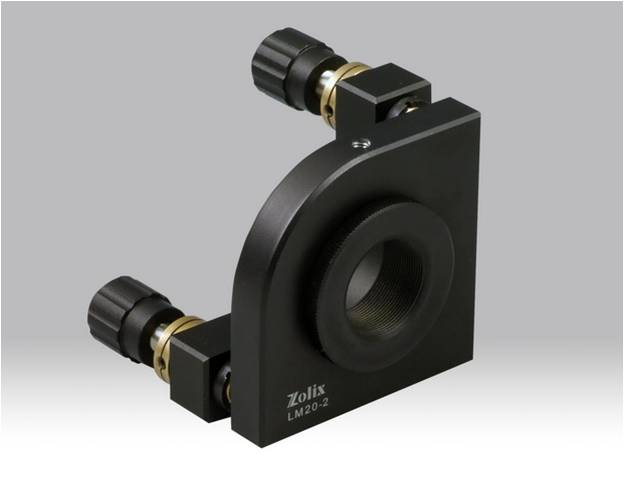
A kinematic mirror mount is a precision opto-mechanical component designed to securely hold an optical mirror while allowing fine angular adjustment about two perpendicular axes.
Unlike fixed mounts, which lock a mirror into a single position, kinematic mounts enable users to make controlled adjustments in pitch and yaw using precision adjustment screws. This allows laser beams and optical paths to be aligned with exceptional accuracy.
The term kinematic refers to a mechanical design that constrains movement using a defined number of contact points. This approach provides highly repeatable positioning while minimising mechanical stress and unwanted movement.
Most precision mirror mounts use a three-point contact arrangement consisting of:
- A cone
- A V-groove
- A flat surface
Together, these contact points define the mirror holder’s position without over-constraining it, allowing precise and repeatable adjustment.
Why are Kinematic Mirror Mounts Important?
In modern optical systems, alignment tolerances can be measured in microradians. Even slight movement caused by vibration, thermal expansion or mechanical drift can significantly affect system performance.
High-quality kinematic mounts help to:
- Maintain precise optical alignment
- Reduce beam pointing errors
- Improve experimental repeatability
- Simplify system setup
- Minimise downtime during realignment
- Increase long-term mechanical stability
Whether you’re working with continuous-wave lasers, ultrafast laser systems or imaging optics, the quality of the mirror mount often determines the stability of the entire optical system.
How Does a Kinematic Mirror Mount Work?
Although designs vary between manufacturers, most precision mirror mounts share the same operating principles.
The mirror is held within a rigid mount body while two precision adjustment screws control angular movement.
One screw adjusts the mirror about the horizontal axis (pitch).
The second adjusts the mirror about the vertical axis (yaw).
A spring preload or flexure mechanism maintains constant contact between the adjustment screws and the mirror holder, eliminating backlash and ensuring smooth movement.
This arrangement provides:
- Fine angular adjustment
- Excellent repeatability
- Stable positioning after adjustment
- Minimal hysteresis
Premium mounts, including many within the Zolix product range, are engineered to provide smooth adjustment with minimal drift, making them suitable for demanding laboratory and industrial environments.
Understanding Kinematic Mount Design
The performance of any mirror mount depends on its mechanical design.
Several engineering factors influence alignment stability.
Three-point Constraint
The classic cone, groove and flat contact arrangement provides deterministic positioning by constraining all six degrees of freedom without introducing unnecessary stress.
This design allows the mirror holder to return to the same position repeatedly after adjustment.
Precision Adjustment Screws
Fine-thread adjustment screws enable extremely small angular changes.
High-quality screws minimise backlash and provide predictable, repeatable movement throughout the adjustment range.
Spring Preloading
Many mounts use carefully selected springs to maintain constant pressure against the adjustment screws.
This ensures:
- Smooth movement
- Reduced vibration
- Consistent adjustment force
- Long-term repeatability
Material Selection
Materials significantly influence thermal stability.
Common materials include:
- Stainless steel
- Aluminium alloys
- Hardened steel
High-quality anodised aluminium offers an excellent balance of rigidity, corrosion resistance and weight.
For demanding environments, stainless steel provides superior thermal and mechanical stability.
Common Applications
Kinematic mirror mounts are used throughout photonics and precision engineering.
Typical applications include:
Laser Beam Steering
Laser systems often require multiple mirrors to guide the beam through complex optical paths.
Kinematic mounts allow each mirror to be aligned precisely while maintaining long-term stability.
Spectroscopy
In Raman, fluorescence and absorption spectroscopy, accurate optical alignment directly affects measurement quality.
Stable mirror positioning helps maximise signal strength while reducing measurement variability.
Microscopy
Modern fluorescence and confocal microscopes rely on accurate beam delivery and optical alignment.
Precision mirror mounts help maintain image quality and optical performance.
Optical Test Systems
Research laboratories frequently reconfigure optical benches for different experiments.
Kinematic mounts allow mirrors to be repositioned quickly while maintaining repeatable alignment.
OEM Instrumentation
Manufacturers of optical equipment often integrate kinematic mirror mounts into permanent systems where long-term reliability is essential.
Choosing the Right Kinematic Mirror Mount
Selecting the correct mirror mount involves more than simply matching the mirror diameter.
Several factors should be considered.
Mirror Size
Ensure the mount is designed for your optic diameter.
Common sizes include:
- Ø12.7 mm (½”)
- Ø25.4 mm (1″)
- Ø50.8 mm (2″)
A correctly sized mount provides adequate support without obstructing the optical aperture.
Adjustment Range
Different applications require different angular adjustment capabilities.
Beam steering applications often benefit from larger adjustment ranges, while high-precision systems may prioritise adjustment sensitivity over travel.
Mechanical Stability
Laboratory environments are rarely vibration-free.
Choose mounts with rigid construction and stable locking mechanisms where required.
Mounting Compatibility
Consider compatibility with:
- Optical posts
- Breadboards
- Translation stages
- Cage systems
Standardised mounting holes simplify system integration.
Environmental Conditions
If your system operates under changing temperatures or continuous vibration, thermal stability and material selection become increasingly important.
The Advantages of Zolix Kinematic Mirror Mounts
Zolix has developed a comprehensive portfolio of precision opto-mechanical components designed for demanding scientific and industrial applications.
Their range of kinematic mirror mounts combines precision engineering with robust mechanical construction to deliver reliable optical alignment across a wide range of systems.
Key features of the Zolix range include:
- Precision-machined construction
- Smooth fine-pitch adjustment mechanisms
- Stable spring-loaded design
- High repeatability
- Compatibility with standard optical components
- Multiple mirror diameter options
- Robust anodised finishes for durability
These characteristics make Zolix mounts suitable for research laboratories, laser development, spectroscopy systems and OEM instrument manufacturers seeking dependable optical alignment solutions.
Why Buy Through Photonic Solutions?
As the exclusive UK distributor for many advanced photonics manufacturers, Photonic Solutions provides access to the complete range of Zolix opto-mechanical components, backed by expert technical support.
Purchasing through Photonic Solutions offers several advantages:
- Expert product selection advice
- UK-based technical support
- Access to the latest Zolix product range
- Support for research, industrial and OEM projects
- Fast and reliable customer service
Rather than simply supplying components, the team works closely with customers to identify the most suitable solution for each application, helping reduce project risk and improve system performance.
Whether you’re specifying a single mirror mount or designing a complete optical platform, expert guidance can make the selection process significantly easier.
Best Practice for Mirror Alignment
Even the highest quality mirror mount performs best when used correctly.
To maximise alignment accuracy:
- Mount all components securely before making adjustments.
- Make small, incremental changes rather than large movements.
- Alternate between adjustment screws when refining beam position.
- Avoid over-tightening locking screws.
- Allow systems to reach thermal equilibrium before performing critical alignment.
- Regularly inspect mounts for contamination or mechanical wear.
These simple practices help maintain long-term stability while reducing unnecessary realignment.
Frequently Asked Questions
What is the difference between a kinematic mirror mount and a fixed mirror mount?
A fixed mirror mount holds the optic in one position with no adjustment capability. A kinematic mirror mount provides precise angular adjustment, allowing mirrors to be accurately aligned within an optical system.
Are kinematic mirror mounts suitable for laser applications?
Yes. They are widely used in laser laboratories and industrial laser systems where accurate beam steering and long-term alignment stability are essential.
What mirror sizes are available?
Manufacturers such as Zolix offer mounts for a range of standard optic diameters, including ½”, 1″ and 2″ mirrors, with additional options available for specialised applications.
Can kinematic mirror mounts be used in research environments?
Absolutely. Their repeatability, precision and mechanical stability make them ideal for universities, national laboratories and industrial R&D facilities.
Conclusion
Kinematic mirror mounts may appear to be simple mechanical components, but they are fundamental to the performance of modern optical systems. Their ability to provide precise, repeatable and stable angular adjustment makes them indispensable in applications ranging from laser beam steering and spectroscopy to microscopy and OEM instrumentation.
By understanding the principles of kinematic design, engineers and researchers can make informed decisions that improve alignment accuracy, reduce system drift and enhance long-term reliability.
For laboratories and organisations seeking dependable opto-mechanical solutions, Zolix’s precision kinematic mirror mounts offer an excellent combination of accuracy, stability and value. Available in the UK through Photonic Solutions, they are backed by expert technical support and a comprehensive portfolio of complementary optical components.
If you’re specifying components for a new optical system or upgrading an existing setup, explore the full range of Zolix Kinematic Mirror Mounts at Photonic Solutions to find the right solution for your application.
Contact our experts to discuss
Or buy now from the photonic shop


