How Raman spectroscopy can help distillers, brands, laboratories and regulators detect adulteration and verify the authenticity of spirits
Counterfeit spirits are more than a threat to brand reputation. For distillers, drinks manufacturers, distributors and regulators, counterfeit alcohol can create financial losses, damage consumer confidence and, in serious cases, introduce hazardous substances into the supply chain.
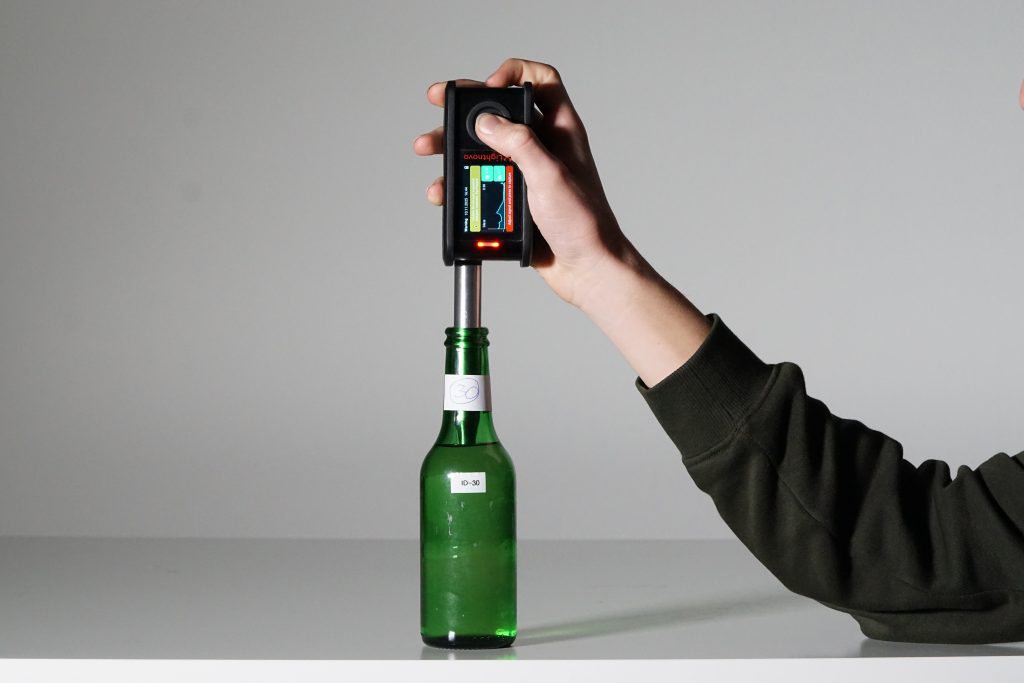
Traditional authenticity testing can provide highly detailed chemical information, but it may require laboratory analysis, sample preparation or opening the bottle. Raman spectroscopy offers a complementary approach: it can rapidly obtain a molecular fingerprint from a spirit, potentially through the original glass container, with little or no sample preparation.
Research has demonstrated the potential of Raman spectroscopy for counterfeit whisky detection, alcohol authentication, adulteration screening, methanol detection, brand classification and non-destructive spirit analysis.
For the alcoholic drinks industry, this creates an intriguing possibility: could a bottle be screened for authenticity without opening it?
The answer, in the right application and with an appropriately validated analytical method, is increasingly yes.
Photonic Solutions supplies Lightnovo Raman spectrometers and Raman microscopes, including compact and portable systems specifically listed for alcohol quality and counterfeit product detection.
Why counterfeit alcohol is such a serious problem
Counterfeiting and adulteration can take several forms.
A counterfeit spirit might contain:
- A cheaper spirit substituted for the genuine product
- Lower-grade alcohol used to stretch an authentic spirit
- Unauthorised flavourings or colourants
- Incorrect alcohol concentration
- Methanol or other toxic alcohols
- A completely different spirit presented as a premium product
- Refilled genuine bottles
- Industrial or surrogate alcohols
- Counterfeit packaging surrounding an adulterated liquid
The problem is particularly significant for high-value spirits, where the economic incentive for fraud is greater.
Whisky is an obvious example. Long maturation periods, established provenance and premium positioning can make individual bottles highly valuable, while the liquid itself can contain a complex combination of compounds associated with production, maturation and finishing.
Researchers from the University of Manchester, University of Liverpool and Scotch Whisky Research Institute investigated Raman spectroscopy specifically for the through-container detection of fake spirits. Their study examined whisky, vodka, rum and gin and demonstrated differentiation between genuine and adulterated products, as well as methanol quantification.
What is Raman spectroscopy?
Raman spectroscopy is a molecular spectroscopy technique that measures the inelastic scattering of laser light.
When laser light interacts with a sample, most photons are scattered elastically through Rayleigh scattering. A very small proportion interact with molecular vibrations and are scattered at different energies.
Those energy shifts form a Raman spectrum.
The spectrum can act as a molecular fingerprint.
For an alcoholic beverage, the measured spectrum can contain information associated with:
- Ethanol
- Methanol
- Water
- Organic compounds
- Flavour compounds
- Colourants
- Congeners
- Other chemical constituents
The analytical challenge is that ethanol and water can dominate the spectrum of many spirits.
This is where chemometrics and multivariate analysis become particularly important.
Why Raman spectroscopy is interesting for spirits authentication
The attraction of Raman spectroscopy for alcohol authentication comes from a combination of characteristics.
Rapid analysis
A Raman measurement can often be acquired in seconds rather than requiring lengthy laboratory preparation.
Minimal sample preparation
Raman spectroscopy generally does not require extraction, reagents or complex sample preparation.
Non-destructive measurement
The sample can potentially remain intact after measurement.
Through-container analysis
Research has demonstrated Raman measurements through glass bottles, potentially allowing an unopened spirit to be screened.
Molecular information
Unlike conventional visual inspection, Raman spectroscopy provides chemical information.
Potential for portable testing
Miniaturised Raman spectrometers can bring analysis outside the laboratory.
For the drinks industry, that combination is particularly attractive for incoming goods inspection, quality control, customs screening, forensic analysis and counterfeit product detection.
Can Raman spectroscopy detect counterfeit whisky?
Research suggests that it can be a useful screening and authentication technique when combined with appropriate reference datasets and chemometric analysis.
A 2017 study by Kiefer and Cromwell investigated single malt Scotch whisky using Raman spectroscopy through the glass wall of the bottle. Using a 785 nm excitation laser, the researchers extracted information relating to cask type, whisky age, alcohol content, filtration and artificial colourants using techniques including principal component analysis and partial least-squares regression.
That is particularly interesting because authenticity is rarely a simple question of:
“Is this ethanol?”
The more useful question is:
“Does the complete spectral fingerprint match what we would expect from this product?”
That distinction is fundamental to counterfeit detection.
Raman spectroscopy for through-bottle alcohol authentication
One of the most exciting developments is through-container Raman spectroscopy.
Instead of opening a bottle, the Raman system focuses the excitation laser through the glass and collects the Raman signal from the liquid inside.
This creates an opportunity for non-invasive alcohol authentication.
The University of Manchester and Scotch Whisky Research Institute study demonstrated through-container Raman analysis using a 1064 nm excitation source. The researchers investigated multiple spirits and reported detection of chemical markers associated with counterfeit alcohol, as well as methanol quantification.
The researchers reported methanol detection limits between 0.23% and 0.39% in the tested spirit types.
A separate 2020 study from researchers at the University of St Andrews demonstrated through-bottle whisky sensing and classification using Raman spectroscopy in an axicon-based backscattering configuration.
These studies demonstrate an important principle:
Raman spectroscopy can potentially interrogate the contents of a sealed bottle without requiring the bottle to be opened.
Why through-bottle Raman spectroscopy matters to the drinks industry
For premium spirits, opening the bottle can undermine some of the advantages of rapid authenticity screening.
Consider a shipment containing hundreds or thousands of bottles.
A conventional laboratory workflow might involve:
Select sample → open bottle → prepare sample → laboratory analysis → result
A non-invasive Raman workflow could instead look like:
Select bottle → measure through glass → compare spectrum → flag for investigation
The Raman measurement does not necessarily replace confirmatory laboratory testing. Instead, it can act as a rapid first-line screening technique.
This distinction is important.
A sophisticated authentication programme could use Raman spectroscopy to identify suspicious samples before sending them for more comprehensive analysis.
That could reduce the number of samples requiring expensive or destructive testing.
Detecting methanol in counterfeit spirits
One of the most important applications is methanol detection in alcoholic beverages.
Methanol is toxic, and its presence at dangerous concentrations in counterfeit or adulterated alcohol has been associated with serious health risks.
The 2019 Analyst study by Ellis et al. investigated handheld 1064 nm Raman spectroscopy for through-container detection of fake spirits and methanol quantification. The researchers analysed several spirit types and demonstrated that Raman spectroscopy could detect chemical markers associated with counterfeit alcohol.
More recent research has also investigated portable Raman spectroscopy for non-destructive measurement of ethanol, methanol and isopropanol concentrations in beverages and spirits. The study developed a through-container approach using a miniature portable Raman system.
This is potentially valuable for:
- Distillery quality control
- Border and customs inspection
- Regulatory testing
- Forensic laboratories
- Distributor quality assurance
- Incoming goods inspection
- Counterfeit screening
However, Raman spectroscopy should not be treated as a universal replacement for validated laboratory methods. Detection limits, bottle geometry, glass composition, sample matrix and calibration all influence performance.
Raman spectroscopy and alcohol adulteration
Counterfeit alcohol does not necessarily contain methanol.
Adulteration can involve substitution or addition of other materials that alter the chemical fingerprint of the beverage.
For example, counterfeiters may attempt to reproduce a premium spirit using:
- Lower-cost alcohol
- Different spirit bases
- Sugar
- Flavourings
- Colourants
- Water
- Industrial alcohol
- Unauthorised additives
A Raman spectrum captures information from the resulting molecular composition.
That means a genuine product can be characterised as a spectral reference, against which unknown samples can be compared.
Using chemometrics to identify counterfeit spirits
This is where Raman spectroscopy becomes particularly powerful.
Two spirit samples can have Raman spectra that look remarkably similar to the human eye.
A computer can analyse the complete spectrum far more effectively.
Common chemometric approaches include:
- Principal Component Analysis (PCA)
- Partial Least Squares (PLS)
- Partial Least Squares Discriminant Analysis (PLS-DA)
- Support Vector Machines (SVM)
- Random Forest
- Cluster analysis
- Spectral similarity analysis
These algorithms can identify subtle differences across hundreds or thousands of spectral measurements.
A 2023 RSC Advances paper described an automated Raman system combined with principal component analysis to distinguish real and counterfeit liquors, including kaoliang liquor, vodka, rum and gin. The study also demonstrated brand classification for liquors with the same alcohol concentration.
A 2024 study went further by applying an improved non-negative matrix factorisation approach to Raman spectra for rapid identification of liquor adulteration.
The message for drinks manufacturers is clear:
Raman authentication is not simply about looking for one Raman peak. It is about recognising a complex spectral fingerprint.
Building a Raman reference library for spirits
For a drinks producer, one of the most useful applications of Raman spectroscopy could be the creation of a reference spectral library.
A reference library might contain measurements from:
- Genuine production batches
- Different bottling dates
- Different maturation ages
- Different cask types
- Different geographical origins
- Different ABV specifications
- Different bottle formats
- Different production sites
- Known adulterated samples
- Known counterfeit samples
An unknown bottle can then be compared against this database.
Over time, the reference library can become increasingly valuable.
For example:
Unknown bottle → Raman spectrum → preprocessing → reference library → chemometric model → authentication score
This approach turns Raman spectroscopy from a simple analytical instrument into part of a broader digital quality-control and authentication workflow.
Raman spectroscopy for whisky authentication
Whisky is particularly well suited to this approach because its chemical composition reflects its production history.
Variables can include:
- Grain or malt composition
- Distillation
- Cask type
- Maturation
- Age
- Filtration
- Colouring
- Blending
- Finishing
The Kiefer and Cromwell study demonstrated that Raman measurements could provide information relating to several of these characteristics, including cask type, age, alcohol content, filtration and artificial colourants.
That makes Raman spectroscopy interesting not only for counterfeit detection, but also for whisky provenance and product verification.
Raman spectroscopy for vodka, gin and rum
The technique is not limited to whisky.
The Ellis et al. study investigated whisky, vodka, rum and gin, demonstrating differentiation between spirit types and analysis of chemical markers associated with counterfeit samples.
This matters because different spirit categories have different chemical fingerprints.
A Raman authentication model can therefore be developed around the specific product category and brand.
For example:
Vodka
Authentication may focus heavily on ethanol concentration and subtle chemical differences.
Gin
Botanical ingredients can introduce additional Raman-active chemical signatures.
Rum
Fermentation, distillation, maturation and flavouring contribute to the spectral fingerprint.
Whisky
Maturation, cask type, age, colourants and production characteristics can all contribute useful information.
The precise analytical strategy should therefore be developed around the product rather than assuming that one universal Raman model will work for every spirit.
Raman spectroscopy for tequila authentication
Research has also investigated Raman spectroscopy specifically for tequila authentication.
A 2022 study developed a non-targeted spatially offset Raman spectroscopy (SORS) method for authenticating white tequilas. The researchers combined SORS with chemometrics and reported successful discrimination of the tested tequila samples using PLS-DA and SVM approaches.
This is significant because SORS can improve access to chemical information from samples through packaging or in the presence of interfering surface signals.
For spirits manufacturers, it reinforces the potential of Raman-based approaches for non-invasive authentication across different spirit categories.
What is SORS and why is it useful for alcohol authentication?
Spatially Offset Raman Spectroscopy (SORS) is a Raman technique designed to improve the detection of signals from beneath or within a surface.
Instead of collecting Raman photons from the same location as the excitation beam, the collection point is spatially offset.
This can help separate signals from:
- Packaging
- Glass
- Surface materials
from signals originating deeper within the sample.
For packaged beverages, that is potentially useful because the bottle itself becomes part of the measurement problem.
Research into tequila authentication has demonstrated the potential of SORS combined with chemometrics for spirit authentication.
Raman spectroscopy versus traditional alcohol testing
Raman spectroscopy does not necessarily replace established analytical techniques.
Instead, it can complement them.
| Technique | Strength | Potential limitation |
|---|---|---|
| Raman spectroscopy | Rapid, molecular fingerprint, potentially non-destructive | Requires appropriate calibration and reference models |
| GC-MS | Highly detailed chemical identification | Laboratory-based, sample preparation often required |
| FTIR | Rapid molecular spectroscopy | Can require careful sampling and interpretation |
| HPLC | Powerful quantitative analysis | Laboratory instrumentation and preparation |
| Density/refractometry | Simple alcohol-related measurements | Limited chemical specificity |
| Visual inspection | Fast and inexpensive | Cannot reliably determine liquid composition |
| Raman + chemometrics | Rapid classification and screening | Model quality depends on representative reference data |
For many authentication programmes, the most effective approach may therefore be tiered analysis:
Level 1 — Rapid Raman screening
Screen a large number of bottles quickly.
↓
Level 2 — Chemometric classification
Compare spectra against validated reference models.
↓
Level 3 — Confirmatory laboratory analysis
Investigate flagged samples using established analytical methods.
This approach can combine speed and scalability with analytical confidence.
Lightnovo Raman spectroscopy for alcohol quality and counterfeit detection
Photonic Solutions supplies Lightnovo Raman spectroscopy systems, including products specifically identified for alcohol quality and counterfeit product detection.
Lightnovo’s compact Raman technology is particularly interesting for applications where Raman analysis needs to move beyond the conventional laboratory.
miniRaman Pro Spectrometer
The Lightnovo miniRaman Pro Spectrometer combines compact dimensions with lab-level Raman performance.
It incorporates an integrated reference channel that automatically corrects for laser wavelength drift, helping maintain stable and reproducible Raman spectra. The system is available with 785 nm, dual 785/660 nm and 830 nm configurations.
Its listed applications include:
- Alcohol quality
- Counterfeit product detection
- Food safety
- Forensics
- Chemical analysis
- Material identification
That makes it a compelling platform for portable Raman spectroscopy and rapid alcohol authentication research.
RG Raman Spectrometer
For applications requiring greater spectral range and resolution, the Lightnovo RG Raman Spectrometer provides a compact research-grade platform.
The RG Raman is available with 405, 532, 633 and 785 nm excitation wavelengths, with spectral ranges extending from low-frequency Raman measurements through to the high-frequency region. Photonic Solutions lists alcohol quality and counterfeit product detection among its applications.
This flexibility can be useful for research teams developing and validating Raman authentication methods.
Raman microscopy for drinks and packaging research
Not every authentication problem involves the bulk liquid.
Packaging, labels, deposits, particles and other physical evidence can also contain valuable information.
A Raman microscope provides spatially resolved Raman analysis, allowing researchers to investigate small areas of a sample.
The Lightnovo RG Raman Microscope combines Raman spectroscopy with optical microscopy and provides diffraction-limited spatial resolution and high throughput.
Potential research applications include investigating:
- Bottle residues
- Pigments
- Labels
- Coatings
- Particles
- Crystalline deposits
- Packaging materials
- Contaminants
This can complement liquid analysis in a wider forensic alcohol authentication workflow.
Raman spectroscopy can also analyse the bottle
An interesting extension of Raman authentication is the analysis of the packaging itself.
A 2025 study published in Forensic Chemistry investigated whisky label authentication using a multimodal workflow incorporating Raman spectroscopy, DESI mass spectrometry imaging and MALDI mass spectrometry imaging.
The researchers found that Raman spectroscopy could provide a rapid, non-invasive initial screening step for whisky labels without opening the bottle.
This suggests a future authentication workflow could potentially examine:
Bottle → Label → Packaging → Liquid
rather than relying solely on the contents.
For premium drinks brands, this is an important development because sophisticated counterfeit operations can replicate both the packaging and liquid.
From laboratory instrument to production-line quality control
The potential of Raman spectroscopy extends beyond forensic investigations.
A sufficiently compact and stable Raman system could potentially support:
- Incoming raw-material inspection
- Batch verification
- Production quality control
- Bottling-line inspection
- Warehouse screening
- Distributor checks
- Customs inspection
- Counterfeit investigations
Research has already explored portable Raman systems and automated Raman measurement platforms for beverage analysis.
This is particularly interesting for OEM integration, where a Raman spectrometer could form part of a larger automated inspection system.
Photonic Solutions’ Raman portfolio includes compact systems designed for research, industrial and OEM applications.
What makes a good Raman system for alcohol authentication?
There is no single specification that determines whether a Raman spectrometer will be suitable.
Important considerations include:
Excitation wavelength
Common Raman excitation wavelengths include:
- 532 nm
- 633 nm
- 660 nm
- 785 nm
- 830 nm
- 1064 nm
Longer wavelengths can be attractive for reducing fluorescence, although they also involve trade-offs in Raman scattering efficiency and detector sensitivity.
The optimum wavelength depends on the spirit, bottle, fluorescence background and required sensitivity.
Spectral range
Authentication may require access to specific Raman bands rather than simply the widest possible spectral range.
Spectral resolution
Higher resolution can help distinguish closely spaced spectral features.
Sensitivity
Low concentrations of adulterants may require a high signal-to-noise ratio.
Calibration stability
For chemometric classification, spectral reproducibility is critical.
Measurement geometry
Through-bottle analysis introduces additional considerations involving:
- Bottle curvature
- Glass thickness
- Glass composition
- Liquid level
- Focusing
- Working distance
Portability
For customs, warehouses, distilleries or field inspections, a compact Raman spectrometer may provide significant practical advantages.
Why laser wavelength matters
Choosing the Raman excitation wavelength is particularly important when analysing spirits.
Shorter-wavelength lasers can produce stronger Raman scattering but may also generate more fluorescence from some samples.
Longer wavelengths, such as 785 nm or 1064 nm, can reduce fluorescence in some applications.
This helps explain why researchers have used both 785 nm and 1064 nm excitation for alcohol authentication studies.
Kiefer and Cromwell used 785 nm excitation for through-bottle Scotch whisky analysis, while Ellis et al. used 1064 nm excitation for through-container counterfeit spirit analysis.
There is therefore no universally correct laser wavelength for “Raman spectroscopy of alcohol”.
The correct choice depends on the sample, bottle, fluorescence background, Raman signal and analytical objective.
Raman spectroscopy and artificial colourants
Colour is an important part of many premium spirits, particularly whisky.
But colour alone cannot establish authenticity.
Raman spectroscopy can potentially provide chemical information associated with colourants and other components.
The 2017 Scotch whisky study reported that partial least-squares regression could provide information about whether a whisky contained artificial colourants, alongside other characteristics such as age and alcohol content.
For producers, this illustrates the broader value of Raman spectroscopy:
It can investigate characteristics of the liquid that cannot be reliably assessed by visual inspection alone.
Raman spectroscopy and alcohol content
Raman spectroscopy can also be used to estimate ethanol concentration.
This is useful because an incorrect ABV can be an indicator of adulteration or substitution.
The 2023 portable Raman study demonstrated non-destructive measurements of ethanol and toxic alcohol strengths in beverages, including through-container measurements.
However, ABV measurement alone is not an authentication test.
A counterfeit spirit can potentially be adjusted to the correct alcohol strength.
The real advantage of Raman is the ability to examine the broader spectral fingerprint.
Raman authentication is about fingerprints, not single peaks
This is perhaps the most important concept for anyone considering Raman spectroscopy for counterfeit alcohol detection.
A genuine premium spirit does not have a single “authenticity peak”.
Instead, authentication relies on a pattern.
That pattern can contain information associated with:
Ethanol + water + congeners + flavour compounds + colourants + production characteristics + maturation
Chemometric models can then determine whether an unknown sample resembles the expected population of authentic products.
This is why a properly designed reference database and validation programme is as important as the Raman spectrometer itself.
Designing a Raman authentication programme
For a drinks producer considering Raman spectroscopy, a sensible development programme could look like this:
1. Build a genuine reference set
Measure authentic products across normal production variation.
2. Characterise known adulterants
Include likely counterfeit and adulteration scenarios.
3. Test packaging variation
Measure different bottle shapes, glass thicknesses, colours and labels.
4. Develop the spectral preprocessing workflow
Account for baseline, fluorescence, intensity and wavelength calibration.
5. Build a chemometric model
Use appropriate classification or regression techniques.
6. Validate against unknown samples
Do not test the model only against samples used to create it.
7. Establish acceptance criteria
Define what constitutes:
- Pass
- Investigate
- Fail
8. Integrate confirmatory testing
Use established laboratory methods for samples that require definitive identification.
This approach can transform Raman from an interesting laboratory technique into a validated quality-control tool.
The future of counterfeit spirit detection
The convergence of Raman spectroscopy, portable instrumentation, chemometrics and machine learning could make authenticity testing increasingly accessible.
Imagine a future workflow in which a bottle is placed beneath a compact Raman system.
The system:
- Measures the bottle without opening it.
- Automatically corrects the spectrum.
- Removes packaging/background contributions.
- Compares the spectrum against a reference library.
- Uses a trained classification model.
- Produces an authentication score.
- Flags unusual samples for laboratory investigation.
Research is already moving in this direction.
Recent work has investigated machine-learning approaches for whisky identification using portable Raman spectroscopy, including measurements made through the original bottle. The authors describe the approach as a rapid, non-destructive initial screening mechanism for falsified and adulterated spirits.
That is an important distinction: Raman can be the fast screening layer within a larger authentication strategy.
Raman spectroscopy for alcohol authentication: the key benefits
For the drinks industry, Raman spectroscopy offers a compelling combination of capabilities:
Non-destructive
Analyse potentially valuable bottles without opening them.
Rapid
Suitable for high-throughput screening.
Minimal preparation
Reduce sample handling and laboratory preparation.
Molecular fingerprinting
Obtain chemical information rather than relying on visual inspection.
Through-container potential
Research demonstrates measurements through glass bottles.
Portable options
Compact Raman instruments can support field and warehouse testing.
Chemometric compatibility
Spectral datasets can be used for classification and authentication models.
Broad applicability
The technique can be investigated across whisky, vodka, gin, rum, tequila and other alcoholic beverages.
The role of Raman spectroscopy in a modern drinks authentication strategy
Raman spectroscopy should not be viewed as a magic “counterfeit detector”.
Instead, it is better understood as a rapid analytical screening technology that can provide a powerful layer of chemical intelligence.
For drinks manufacturers, an effective authentication strategy might combine:
Packaging inspection
↓
Raman spectroscopy
↓
Chemometric classification
↓
Targeted laboratory analysis
↓
Forensic confirmation
This layered approach can help balance speed, cost, non-destructive testing and analytical confidence.
For premium spirits brands, where individual bottles may carry significant financial and reputational value, that combination is increasingly attractive.
Explore Raman spectroscopy for alcohol quality and counterfeit detection
Photonic Solutions supplies Lightnovo Raman spectroscopy solutions for research, industrial and quality-control applications.
The miniRaman Pro Spectrometer combines a compact format with high sensitivity, spectral stability and an integrated reference channel, while its listed applications specifically include alcohol quality and counterfeit product detection.
The RG Raman Spectrometer provides a research-grade platform with multiple laser wavelength options and a broad spectral range, making it suitable for developing more advanced Raman authentication methodologies.
For spatially resolved investigations, the RG Raman Microscope combines Raman analysis with optical microscopy.
Photonic Solutions also supplies a Raman Spectrometers portfolio covering compact, portable and research-grade systems.
Frequently asked questions about Raman spectroscopy and counterfeit alcohol
Can Raman spectroscopy detect counterfeit spirits?
Raman spectroscopy can help distinguish genuine and adulterated spirits by comparing their molecular fingerprints. Published research has demonstrated classification of genuine and counterfeit whisky, vodka, rum, gin and other spirits.
Can Raman spectroscopy test whisky without opening the bottle?
Yes. Research has demonstrated Raman measurements through glass bottles, including Scotch whisky.
Can Raman spectroscopy detect methanol in alcohol?
Research has demonstrated methanol detection and quantification in spirits using Raman spectroscopy, including through-container measurements.
Can Raman spectroscopy measure alcohol concentration?
Yes. Raman spectroscopy can be used to estimate ethanol concentration, although a validated method is required for quantitative measurements.
Can Raman identify different whisky brands?
Research has demonstrated discrimination between different liquor brands using Raman spectroscopy and chemometric methods.
Can Raman spectroscopy authenticate tequila?
Yes. Published research has investigated spatially offset Raman spectroscopy combined with chemometrics for authenticating white tequila samples.
Is Raman spectroscopy better than GC-MS for counterfeit alcohol?
Not necessarily. The techniques have different strengths. Raman can offer rapid, non-destructive screening with minimal preparation, while GC-MS can provide highly detailed chemical identification. In many real-world authentication programmes, Raman could complement rather than replace laboratory methods.
Can Raman spectroscopy be used in a distillery?
Potentially, yes. Compact Raman systems can support research, quality control, incoming inspection and authentication workflows. The appropriate configuration depends on the measurement objective, sample, packaging and required validation.
Conclusion: a new analytical tool for protecting premium spirits
Counterfeit alcohol presents a complex challenge because fraud can involve both the liquid and the packaging.
Visual inspection can identify obvious anomalies, but it cannot reliably establish chemical authenticity.
Laboratory techniques provide powerful chemical information, but can involve time, cost and sample preparation.
Raman spectroscopy occupies an interesting middle ground.
It can provide rapid molecular information, requires little sample preparation and, under suitable conditions, can analyse a spirit through its original container.
Published research has demonstrated applications ranging from Scotch whisky authentication and counterfeit spirit detection to methanol measurement, tequila authentication and machine-learning classification.
For distillers, premium drinks brands, laboratories, customs authorities and drinks-industry quality teams, the opportunity is compelling: use Raman spectroscopy as a rapid, non-destructive screening layer that identifies suspicious products before more extensive analytical investigation is required.
Photonic Solutions can help you explore whether Raman spectroscopy is appropriate for your alcohol authentication, counterfeit detection or drinks quality-control application.
Talk to the Photonic Solutions spectroscopy team →
Further Reading
Ellis et al., Analyst — Rapid through-container detection of fake spirits and methanol quantification with handheld Raman spectroscopy.
Kiefer & Cromwell, Analytical Methods — Analysis of single malt Scotch whisky using Raman spectroscopy.
Fleming et al., Analytical Methods — Through-bottle whisky sensing and classification using Raman spectroscopy in an axicon-based backscattering configuration.
Pérez-Beltrán et al., Microchemical Journal — Non-targeted spatially offset Raman spectroscopy-based vanguard analytical method to authenticate spirits: White Tequilas as a case study.
Chi et al., RSC Advances — Development of an automated Raman system and use of principal component analysis to classify real and counterfeit liquors.
Yi et al., Spectrochimica Acta Part A — Identification of liquor adulteration by Raman spectroscopy method based on ICNAFS.
Giannoutsou et al., Biosensors — Non-Destructive and Non-Invasive Measurement of Ethanol and Toxic Alcohol Strengths in Beverages and Spirits Using Portable Raman Spectroscopy.
Tibljas et al., Forensic Chemistry — Multimodal analytical approach applied to whisky labels for authenticity determination.