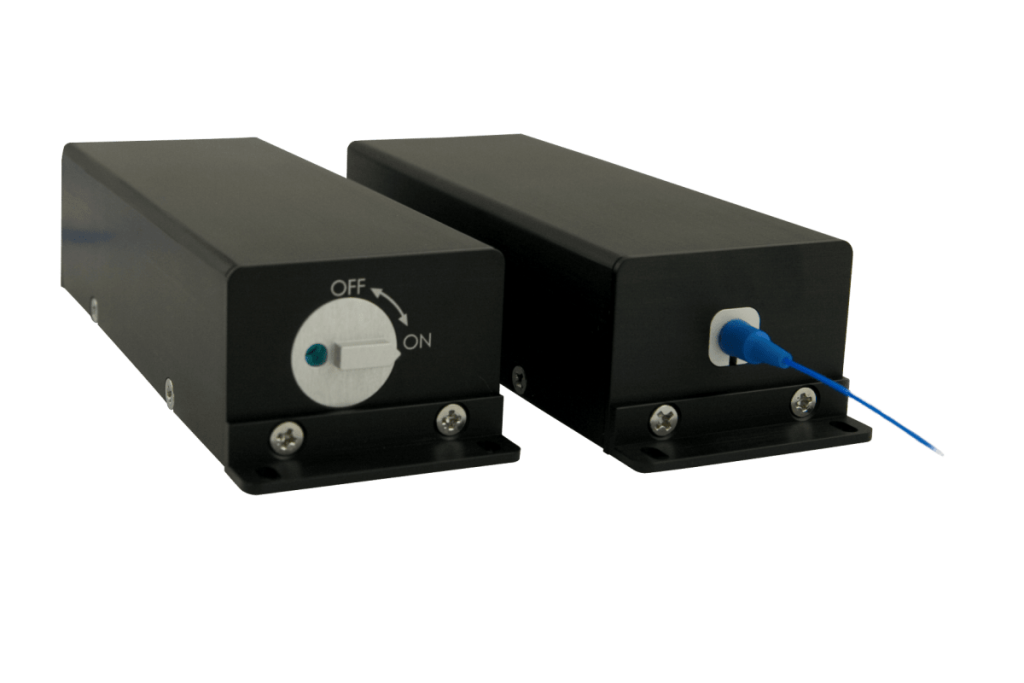
When your laser system needs a new wavelength, nonlinear frequency conversion provides a powerful way to extend its capabilities without changing the source itself. HC Photonics PPXX bulk and waveguide mixers provide compact, efficient solutions for generating new wavelengths from the UV through to the near- and mid-infrared.
What is a PPXX mixer?
PPXX devices use periodically-poled nonlinear crystals, including PPLN and PPLT, to exploit quasi-phase matching (QPM) for efficient frequency conversion.
Depending on the configuration, a single input wavelength can be converted using processes such as:
- Second-harmonic generation (SHG) – doubling the optical frequency
- Sum-frequency generation (SFG) – combining two input frequencies
- Difference-frequency generation (DFG) – generating a lower-frequency output
- Third-harmonic generation (THG)
- Cascaded nonlinear processes
This makes PPXX mixers useful when a conventional laser does not provide the wavelength required for an application.
Bulk or waveguide – which is right for your application?
The choice between a bulk and waveguide mixer largely comes down to power, efficiency and optical coupling.
Bulk mixers provide excellent power handling and are well suited to applications requiring higher optical powers. Waveguide mixers, meanwhile, confine the optical field within the nonlinear material, enabling very high conversion efficiency from relatively low input powers.
HC Photonics’ waveguide SHG range, for example, covers output wavelengths from approximately 450–800 nm, with typical conversion efficiencies of up to 120%/W, depending on wavelength. Fibre-coupled versions can also provide around 80% coupling efficiency from the waveguide to a single-mode PM fibre.
Designed for straightforward integration
PPXX mixers are designed as practical, compact components rather than laboratory-only nonlinear crystals. Configurations can incorporate integrated coupling optics, fibre interfaces, thermoelectric temperature control and optional photodiode power monitoring.
Temperature control is particularly important because the periodic poling condition needs to be maintained for optimum quasi-phase matching. The integrated TEC allows the operating temperature to be controlled accordingly.
Where are PPXX mixers used?
The flexibility of PPXX technology makes it suitable for a wide range of photonics applications, including:
Quantum technologies
Generation of wavelengths for quantum communication, photon sources and single-photon applications.
Spectroscopy and sensing
Accessing wavelengths that are difficult to obtain directly from conventional laser sources.
Biomedical imaging
Efficient wavelength conversion for imaging and microscopy techniques.
Scientific research
SHG, SFG, DFG, OPA, OPG, OPO and other nonlinear optical experiments.
OEM and industrial systems
Compact, robust frequency-conversion modules can be incorporated into larger laser and instrumentation platforms.
Why choose PPXX?
For system designers, the key advantage is efficient wavelength conversion in a compact, readily integrated package. Rather than building a nonlinear optical system around a bare crystal, PPXX mixers combine the nonlinear element with the optical and thermal components needed for practical operation.
HC Photonics can also optimise mixers around a customer’s specific pump wavelength and nonlinear process, making the technology suitable for both standard and application-specific requirements.
Need to generate a specific wavelength?
Photonic Solutions can help you select the appropriate PPXX bulk or waveguide mixer, based on your pump source, required output wavelength, optical power and conversion process.