What is hyperspectral imaging, how does it work, and where is it used?
Hyperspectral imaging (HSI) combines imaging and spectroscopy to reveal both where something is and what it is made of. Unlike conventional imaging, which records information across a small number of colour channels, a hyperspectral imaging system measures many narrow wavelength bands across a continuous or finely sampled spectral range.
The result is a hyperspectral data cube containing two spatial dimensions and one spectral dimension. Every pixel can therefore contain a spectrum, allowing researchers and engineers to identify, classify and map materials based on their optical properties.
For applications ranging from medical imaging and life sciences to agriculture, semiconductor inspection, pharmaceuticals, materials analysis and environmental sensing, hyperspectral imaging can reveal chemical and structural differences that are invisible to a conventional camera.
Photonic Solutions supplies advanced hyperspectral cameras, hyperspectral microscopes, SWIR imaging systems and OEM hyperspectral sensors, including solutions from Photon etc. and SensIR.
This guide explains the principles of hyperspectral imaging, the different technologies available, important system specifications and how to choose the right hyperspectral imaging system for your application.
What is hyperspectral imaging?
Hyperspectral imaging is an imaging technique that records spatial and spectral information simultaneously.
A conventional colour camera normally records three broad spectral channels:
Red + Green + Blue → Image
A hyperspectral camera instead records many narrow wavelength channels:
X position + Y position + wavelength → Hyperspectral data cube
This additional spectral information allows each pixel to be associated with a characteristic spectrum.
For example, two materials might look almost identical in a normal photograph but have different reflectance or absorption characteristics in the near-infrared.
A hyperspectral camera can distinguish between them by analysing their spectral signatures.
This makes hyperspectral imaging particularly useful when the objective is not simply to see an object, but to identify, classify or characterise the material within an image.
What is a hyperspectral data cube?
The term hyperspectral data cube describes the three-dimensional dataset produced by a hyperspectral imaging system.
The axes represent:
- X – spatial position
- Y – spatial position
- λ – wavelength
Every spatial location therefore contains spectral information.
Imagine selecting one pixel from a hyperspectral image. Instead of obtaining a single RGB value, you can extract a complete spectrum.
This enables researchers to create:
- Spectral maps
- Material classification images
- Chemical distribution maps
- Reflectance maps
- Fluorescence maps
- Photoluminescence maps
- Absorption maps
Photonic Solutions’ V-EOS, S-EOS, Grand-EOS and IMA systems use this principle to combine spatial and spectral information into hyperspectral data cubes.
Hyperspectral imaging vs multispectral imaging
The terms hyperspectral and multispectral imaging are sometimes used interchangeably, but they describe different approaches.
Multispectral imaging
A multispectral system typically measures a relatively small number of selected wavelength bands.
For example:
450 nm → 550 nm → 650 nm → 850 nm
This can be highly effective when the application is already well understood and only particular wavelengths are required.
Hyperspectral imaging
A hyperspectral system measures many spectral channels across a defined wavelength range.
For example:
400–1000 nm with continuously tunable spectral channels
This provides much more information about the spectral characteristics of each pixel.
Hyperspectral imaging is therefore particularly valuable when:
- The material signature is unknown
- Several materials need to be distinguished
- Subtle spectral differences matter
- Chemical composition needs to be mapped
- Researchers need to explore a broad spectral range
The right approach ultimately depends on the application, required spectral resolution, acquisition speed and amount of spectral information needed.
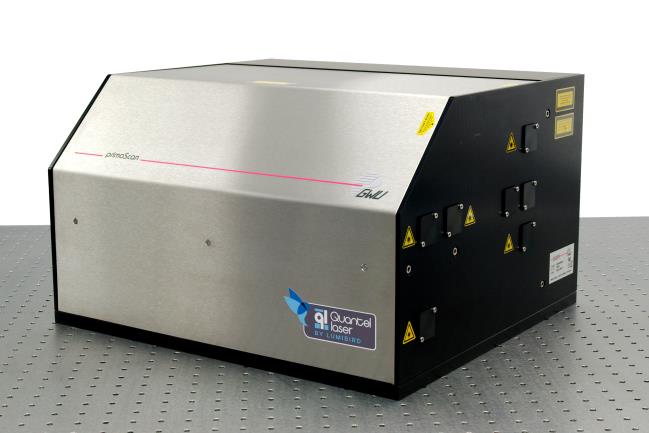
The primoScan from Quantel by Lumibird is a fully integrated, computer-controlled optical parametric oscillator (OPO) designed for high-energy, wavelength-tunable laser excitation. Combining a 355 nm Nd:YAG pump laser with a sophisticated OPO architecture, primoScan provides broad wavelength coverage from the UV through to the near- and short-wave infrared, making it a versatile source for advanced spectroscopy and scientific research.
The system offers an exceptionally broad tuning range of 190 nm to 2.75 µm, depending on configuration. The broadband versions provide signal wavelengths from 405–690 nm and idler wavelengths from 730–2700 nm, while ultra-low-divergence (ULD) versions extend UV operation from 190–405 nm. This makes primoScan suitable for experiments requiring access to multiple spectral regions from a single laser platform.
PrimoScan is fully motorised and computer-controlled, with shot-to-shot wavelength switching in less than 100 ms. This enables rapid wavelength selection during automated measurements and reduces the need for manual optical adjustment. The OPO can also be configured for ultra-low beam divergence of <2 mrad, supporting applications where beam quality and efficient optical delivery are important.
Available configurations deliver pulse energies of up to 205 mJ at 450 nm at 10 Hz, while the ULD/500 configuration can provide up to 155 mJ at the same wavelength. OPO pulse duration is typically 0–3 ns shorter than the pump laser, with linewidths ranging from 3.5–6 cm⁻¹ for ULD configurations.
Typical applications include laser-induced fluorescence (LIF), material analysis, combustion studies, remote sensing, multiphoton interactions, biotechnology and medical research. With its wide tuning range, automated wavelength control and configurable beam characteristics, primoScan provides a flexible platform for demanding wavelength-selective experiments.

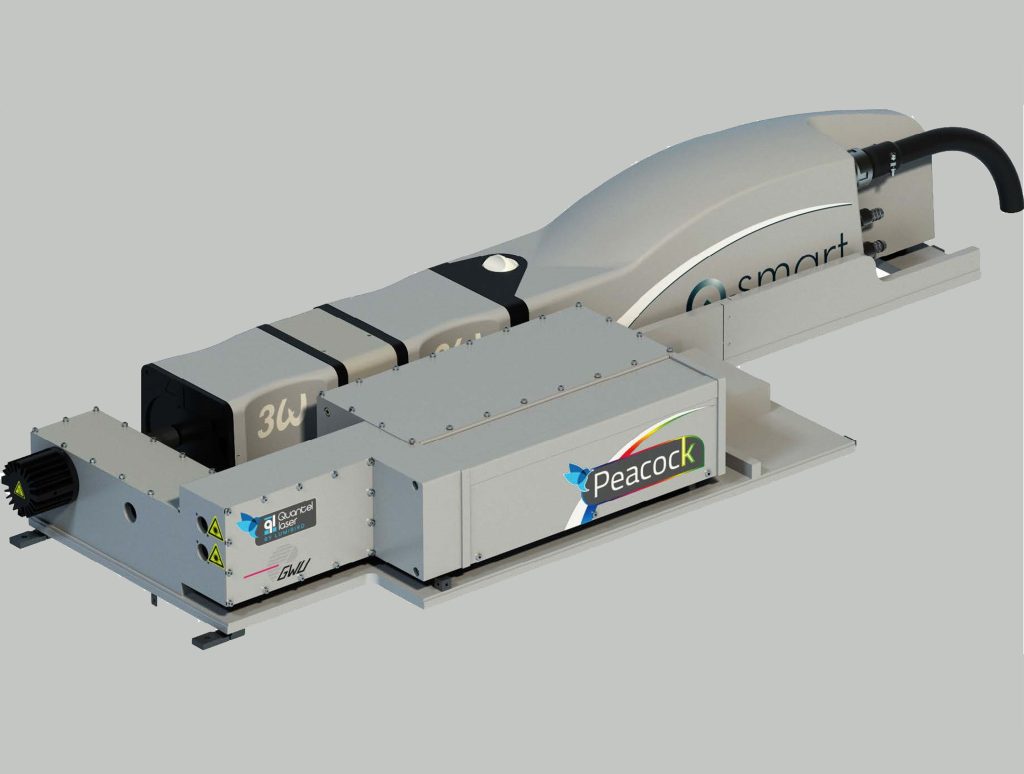
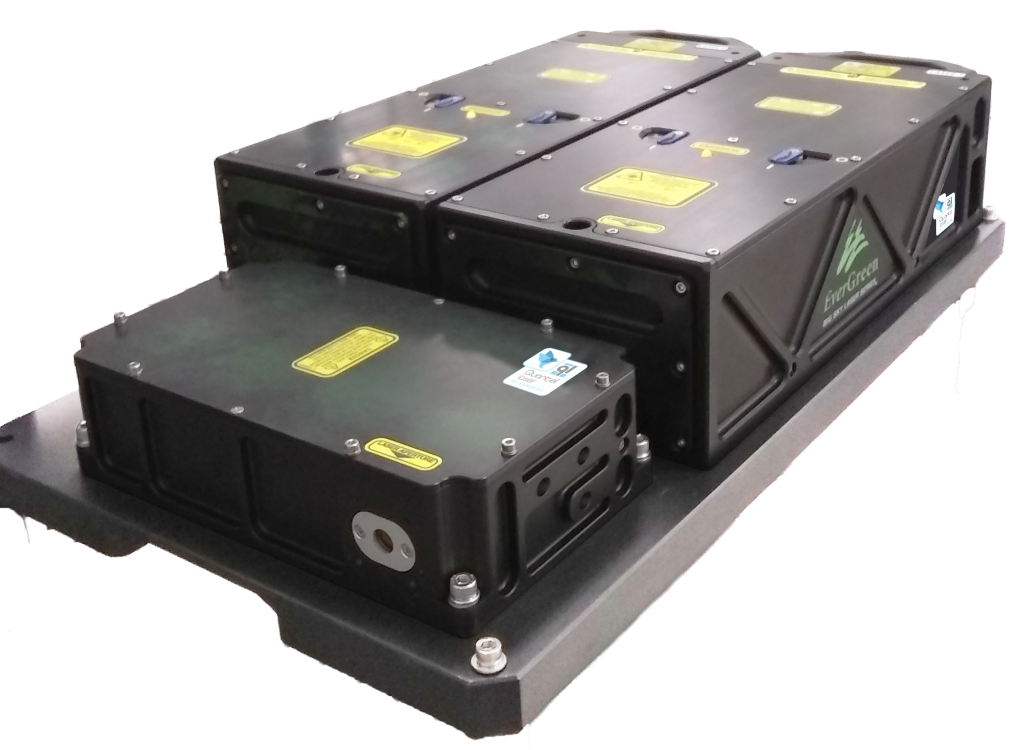
The Quantel by Lumibird EverGreen Twins is a high-performance, four-pulse Nd:YAG laser system designed for advanced particle image velocimetry (PIV), fluid mechanics and flow visualisation applications. Combining two synchronised EverGreen dual-pulse laser systems, it delivers four precisely overlapped laser pulses at 532 nm, enabling researchers to capture complex flow dynamics with enhanced temporal resolution and an extended velocity measurement range.
The EverGreen Twins is available in three energy configurations, delivering 4 × 60 mJ, 4 × 125 mJ or 4 × 175 mJ per pulse sequence at a repetition rate of 15 Hz. Its four-pulse architecture enables advanced PIV techniques, allowing users to investigate acceleration and transient flow behaviour in addition to conventional velocity measurements. The precisely overlapped green beams produce a consistent illumination field, supporting reliable particle tracking and correlation analysis.
Designed for demanding laboratory and field environments, the EverGreen Twins combines a rugged, compact construction with practical features for straightforward deployment. The laser head is IP66 sealed and compliant with MIL-STD-810 requirements for vibration and shock resistance. Grab-and-go handles, quick-disconnect cables and an integrated cooling and electronics unit simplify transportation and setup. The system is designed to move from its shipping case to laser operation in less than 10 minutes.
The EverGreen Twins also offers long-term operational reliability, with a two-year warranty covering the system, optics and beam overlap. Flashlamps are guaranteed for up to 100 million shots, subject to the manufacturer’s warranty conditions.
Typical applications include particle image velocimetry (PIV), laser-induced fluorescence (LIF), combustion research, fluid mechanics and advanced flow diagnostics. Its four-pulse capability makes it particularly suitable for experiments requiring high temporal accuracy and detailed analysis of rapidly changing flow fields.
How does hyperspectral imaging work?
There are several approaches to acquiring hyperspectral images.
Traditional systems often use one of three architectures:
Point scanning
A single point or small region is measured and scanned across the sample.
This can provide high spectral information but may be relatively slow for large areas.
Line scanning
A line of the sample is imaged while either the sample or imaging system moves.
This approach, sometimes called push-broom hyperspectral imaging, is widely used for industrial inspection and remote sensing.
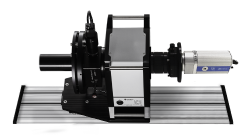
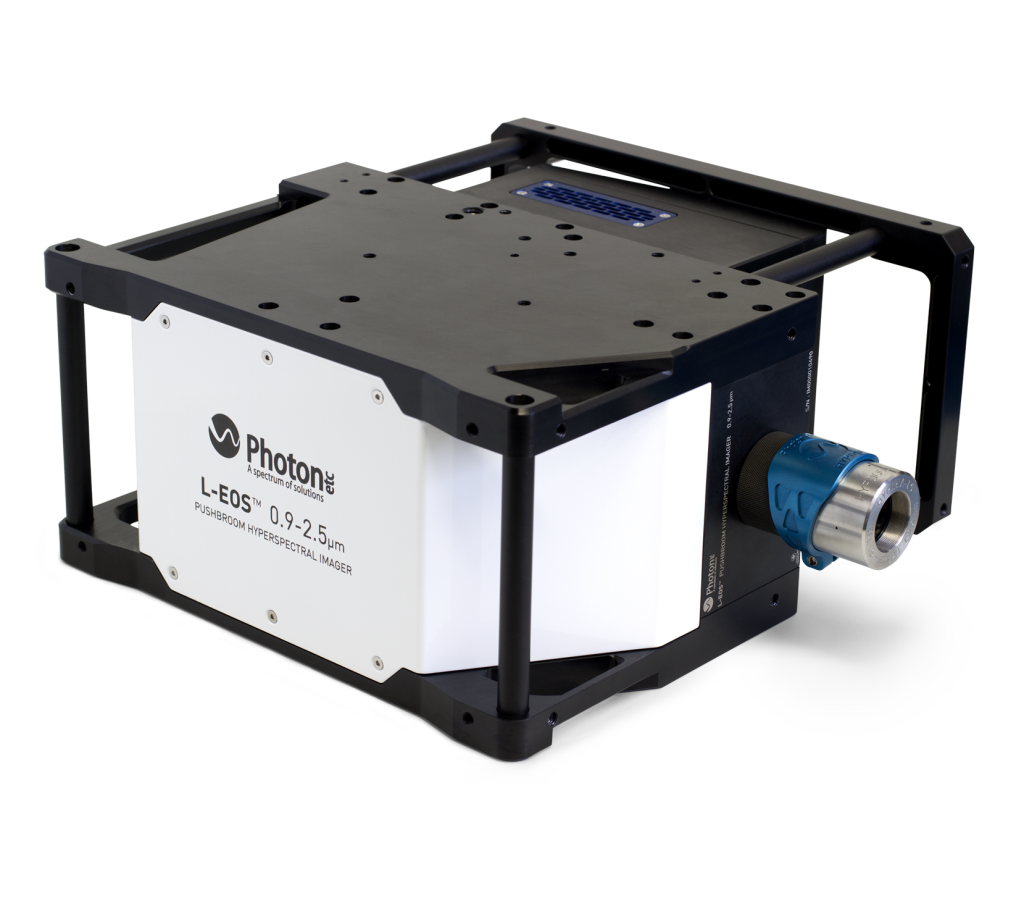
Photonic Solutions supplies the L-EOS Push broom hyperspectral scanner, which is optimised for the 900–2800 nm range and combines a reflective spectrometer with scientific-grade infrared cameras and optics.
Global or snapshot imaging
A global imaging system captures information across the field of view rather than building the image one line at a time.
Photon etc.’s hyperspectral systems use Bragg Tunable Filter technology for wavelength selection. This approach allows global hyperspectral imaging and avoids some of the limitations associated with conventional scanning approaches.
What is global hyperspectral imaging?
Global hyperspectral imaging captures spectral information across the entire field of view rather than relying on point-by-point or line-by-line scanning.
This can be particularly advantageous when imaging dynamic samples or when rapid acquisition is important.
Photon etc.’s global imaging systems use tunable optical filtering to select wavelengths across the field of view. Their systems can generate hyperspectral data cubes from a sequence of monochromatic images without requiring conventional image reconstruction.
This technology is used across Photon etc.’s hyperspectral imaging and microscopy portfolio.
Explore Hyperspectral & SWIR Imaging.
Understanding hyperspectral wavelength ranges
Choosing the correct wavelength range is one of the most important decisions when specifying a hyperspectral imaging system.
Different materials interact with different regions of the electromagnetic spectrum.
Visible hyperspectral imaging
The visible region, approximately 400–700 nm, is useful for studying colour, reflectance, fluorescence and visible optical signatures.
Photonic Solutions’ V-EOS hyperspectral camera covers 400–1000 nm, extending into the near-infrared. It provides full-field hyperspectral imaging with spectral resolution below 2 nm FWHM.
Typical applications include:
- Colour analysis
- Fluorescence
- Plant imaging
- Materials research
- Semiconductor inspection
- Forensic analysis
NIR hyperspectral imaging
Near-infrared (NIR) hyperspectral imaging typically extends from around 700 nm into the 1700 nm region.
NIR spectroscopy and hyperspectral imaging are particularly valuable for analysing organic materials, biological samples, agricultural products and polymers.
Photonic Solutions supplies NIR hyperspectral systems covering ranges such as 900–1620 nm and 900–1700 nm.
The S-EOS 1.7 system covers approximately 900–1700 nm using InGaAs detection, while the S-EOS 2.5 extends the range towards 2500 nm using an MCT detector.
Explore NIR and SWIR Cameras.
SWIR hyperspectral imaging
Short-wave infrared (SWIR) imaging extends spectral analysis beyond the visible and conventional NIR range.
SWIR wavelengths can provide useful information about:
- Moisture
- Chemical composition
- Organic materials
- Pharmaceuticals
- Minerals
- Plastics
- Semiconductor materials
- Agricultural products
Photonic Solutions supplies hyperspectral systems and SWIR cameras covering ranges up to approximately 2500–2800 nm, depending on the system.
The L-EOS hyperspectral scanner, for example, spans configurations from approximately 900 to 2800 nm.
MWIR hyperspectral imaging
For applications requiring longer infrared wavelengths, mid-wave infrared (MWIR) hyperspectral imaging can provide additional chemical and thermal information.
Photonic Solutions’ SensIR MWIR Hyperspectral Camera covers 2500–5000 nm and is available with 320 or 640 spatial channel options.
This makes MWIR hyperspectral imaging relevant to specialist applications where information beyond the SWIR range is required.
Hyperspectral microscopy
Hyperspectral imaging becomes even more powerful when combined with microscopy.
A hyperspectral microscope adds spectral information to microscopic spatial resolution, allowing researchers to determine not only where a feature occurs but also its spectral characteristics.
This is particularly useful when analysing:
- Cells
- Tissues
- Biological structures
- Semiconductor materials
- Thin films
- Photovoltaic materials
- Nanomaterials
- Fluorescent samples
Photonic Solutions supplies Photon etc.’s IMA Global Hyperspectral Microscope, which provides spectral and spatial information across VIS, NIR and SWIR ranges.
Explore Hyperspectral and SWIR Microscopes.
IMA Global Hyperspectral Microscope
The IMA Global Hyperspectral Microscope is designed for researchers who need spatially resolved spectral information at microscopic scales.
The system can generate maps of:
- Photoluminescence
- Fluorescence
- Electroluminescence
- Reflectance
- Transmittance
The VIS configuration covers approximately 400–1000 nm, while the SWIR configuration covers approximately 900–1620 nm. The system uses global imaging rather than conventional point-by-point or line-scanning acquisition.
This makes IMA particularly relevant to life sciences and materials science.
View the IMA Global Hyperspectral Microscope.
Grand-EOS: combining microscopy and wide-field hyperspectral imaging
The Grand-EOS Global Hyperspectral Wide-Field Camera combines hyperspectral microscopy with wide-field hyperspectral imaging.
This gives researchers access to both microscopic and macroscopic measurements within one platform.
The system covers:
- 400–1000 nm in the visible configuration
- 900–1620 nm in the SWIR configuration
Grand-EOS uses Photon etc.’s volume Bragg grating-based filtering technology and generates hyperspectral data cubes containing both spatial and spectral information.
This architecture is particularly useful when research requires information across different spatial scales.
View the Grand-EOS Hyperspectral Camera.
V-EOS wide-field hyperspectral imaging
The V-EOS is a global hyperspectral camera designed for full-field spectral analysis across 400–1000 nm.
It provides spectral resolution below 2 nm FWHM and uses an sCMOS camera.
The system is designed for:
- Reflectance imaging
- Transmittance imaging
- Luminescence imaging
- Photovoltaic materials characterisation
- Counterfeit examination
- Forensic research
- Food sorting
- Plant analysis
Its field of view can also be configured for different sample sizes.
View the V-EOS Hyperspectral Wide-Field Camera.
S-EOS infrared hyperspectral imaging
When the information of interest lies in the NIR or SWIR, the S-EOS provides an infrared hyperspectral imaging solution.
Two standard configurations cover approximately:
S-EOS 1.7: 900–1700 nm
S-EOS 2.5: 900–2500 nm
The systems use InGaAs or MCT detection and provide continuously tunable spectral channels.
Applications include:
- Photovoltaic characterisation
- Food and plant sorting
- Forensic analysis
- Counterfeit examination
- Materials research
View the S-EOS Infrared Hyperspectral Camera.
OEM hyperspectral cameras
Hyperspectral imaging is increasingly moving from research laboratories into industrial instruments, production lines and embedded sensing systems.
This creates a requirement for compact, robust and configurable OEM hyperspectral cameras.
Photonic Solutions supplies SensIR hyperspectral cameras covering:
- VNIR: approximately 350–1000 nm
- NIR: approximately 900–1700 nm
- SWIR: approximately 1000–2500 nm
The available configurations vary in spectral resolution, spatial resolution, spectral range, imaging speed and integration options. Customised spectral cameras are also available.
Explore OEM Hyperspectral Cameras.
Hyperspectral imaging for industrial inspection
One of the most valuable applications for hyperspectral imaging is industrial inspection.
Conventional machine vision primarily identifies differences in shape, colour, brightness and texture.
Hyperspectral imaging adds another dimension: spectral composition.
This means that a production system can potentially identify materials that appear visually identical but have different spectral signatures.
Applications include:
- Material sorting
- Product inspection
- Contaminant detection
- Pharmaceutical inspection
- Semiconductor inspection
- Quality control
- Process monitoring
- Mineral analysis
Photonic Solutions supports industrial and manufacturing applications with photonic technologies for inspection and analysis, including spectroscopy and hyperspectral systems.
Explore Industrial & Manufacturing applications.
Hyperspectral imaging for agriculture
Agriculture is a particularly strong application for NIR and hyperspectral imaging.
Plant and agricultural materials contain chemical information that can be detected spectrally.
Hyperspectral imaging can support applications such as:
- Crop monitoring
- Plant health analysis
- Food sorting
- Quality control
- Moisture analysis
- Material classification
- Agricultural product inspection
Photonic Solutions’ agriculture portfolio brings together NIR, hyperspectral and atmospheric sensors to support productivity and sustainability.
Systems such as S-EOS provide NIR/SWIR hyperspectral imaging capabilities for food and plant sorting.
Explore Hyperspectral Imaging for Agriculture.
Hyperspectral imaging for food analysis
Food products can contain subtle variations in composition that are difficult to identify visually.
NIR and SWIR hyperspectral imaging can provide spatially resolved information about materials such as:
- Moisture
- Organic composition
- Surface characteristics
- Contamination
- Product uniformity
The advantage of imaging rather than point spectroscopy is that the measurement can show where a particular spectral signature occurs.
This can be valuable for automated sorting and quality-control systems.
Hyperspectral imaging for pharmaceuticals
Pharmaceutical manufacturing requires accurate identification and monitoring of materials throughout the production process.
Hyperspectral imaging can provide spatial and spectral information for applications including:
- Raw material identification
- Tablet analysis
- Coating inspection
- Contamination detection
- Process monitoring
- Quality control
Photonic Solutions’ hyperspectral portfolio includes systems intended for pharmaceutical and materials-analysis applications, including the Photon etc. HyperCube.
Explore Pharmaceutical applications.
Hyperspectral imaging for medical and life sciences
Hyperspectral imaging can provide researchers with additional information about biological samples without relying solely on conventional colour or intensity images.
Potential applications include:
- Tissue analysis
- Fluorescence imaging
- Cellular imaging
- Photoluminescence
- Biological research
- Optical diagnostics
Photonic Solutions specifically identifies hyperspectral imaging, light microscopy and optical spectroscopy as technologies supporting medical and life-science research.
The IMA hyperspectral microscope is designed for life-science and materials-science applications, while Photon etc.’s wider portfolio includes hyperspectral microscopy and infrared imaging.
Hyperspectral imaging for semiconductor and materials research
Materials often exhibit subtle optical signatures that vary with composition, structure or electronic properties.
Hyperspectral imaging can map these differences spatially.
Applications can include:
- Semiconductor inspection
- Thin-film analysis
- Photovoltaic materials
- Photoluminescence mapping
- Electroluminescence mapping
- Defect analysis
- Materials characterisation
The HyperCube platform, for example, is designed for applications including materials analysis, semiconductor inspection and quality control, as well as life-science research.
Raman hyperspectral imaging
Hyperspectral imaging can also be combined with Raman spectroscopy.
Raman hyperspectral imaging provides spatially resolved molecular information by measuring Raman spectra across an image.
This allows researchers to generate chemical maps of a sample rather than measuring one point at a time.
Photonic Solutions supplies the 532 Raman Hyperspectral system, a complete 532 nm Raman hyperspectral solution with a spectral range of 50–200 cm⁻¹, a 532 nm excitation laser and EMCCD camera.
This makes Raman hyperspectral imaging particularly interesting for:
- Materials research
- Chemical mapping
- Pharmaceutical analysis
- Semiconductor research
- Biological samples
Hyperspectral imaging vs Raman imaging
Both techniques provide spatially resolved spectral information, but they answer different questions.
Hyperspectral reflectance/transmittance imaging measures how a sample interacts with illumination across wavelength.
Raman hyperspectral imaging measures the inelastic scattering of light and provides molecular vibrational information.
The appropriate technique depends on the chemical and physical information required.
For applications requiring molecular identification, Raman can provide highly specific chemical fingerprints.
For broad material classification, reflectance, transmittance or infrared hyperspectral imaging may be more appropriate.
Photonic Solutions supplies both Raman spectroscopy and hyperspectral imaging technologies, allowing the technique to be selected around the application rather than forcing the application around the instrument.
What are the key specifications of a hyperspectral camera?
Choosing a hyperspectral camera requires more than looking at its headline wavelength range.
The most important specifications include:
Spectral range
The wavelength range determines which optical signatures the system can measure.
Common ranges include:
- Visible
- VNIR
- NIR
- SWIR
- MWIR
Choose the range according to the spectral features of the material being investigated.
Spectral resolution
Spectral resolution determines how closely two wavelengths can be distinguished.
Higher spectral resolution can be important when small spectral features need to be separated.
However, higher resolution is not automatically better. It can come at the expense of signal, acquisition speed or spectral range.
The correct balance depends on the application.
Spatial resolution
Spatial resolution determines how finely the system can distinguish features within the image.
A system for agricultural sorting may have very different spatial requirements from a hyperspectral microscope investigating cellular structures.
Spectral channels
The number and spacing of spectral channels determine how densely the spectrum is sampled.
Some hyperspectral systems use fixed spectral channels, while others provide continuously tunable wavelength selection.
Photon etc.’s global hyperspectral systems use continuously tunable spectral channels across their operating ranges.
Acquisition speed
Speed becomes particularly important for:
- Moving samples
- Production lines
- Live biological samples
- Dynamic experiments
- High-throughput inspection
A slow but extremely high-resolution system may be inappropriate if the sample changes during acquisition.
Detector technology
The detector must be appropriate for the wavelength range.
Examples include:
- Silicon/sCMOS or CCD for visible wavelengths
- InGaAs for NIR/SWIR
- MCT/HgCdTe for longer infrared wavelengths
Photonic Solutions’ portfolio includes InGaAs, MCT and sCMOS-based hyperspectral systems.
How do you choose a hyperspectral imaging system?
Start with the application rather than the camera.
Step 1: Identify the material
What are you measuring?
For example:
- Biological tissue
- Plants
- Food
- Pharmaceuticals
- Minerals
- Semiconductors
- Thin films
- Polymers
Step 2: Identify the spectral signature
Determine which wavelength region contains the information you need.
Step 3: Determine the spatial scale
Are you imaging:
- A large production area?
- A plant?
- A sample?
- A microscopic structure?
- A semiconductor wafer?
Step 4: Determine the required spectral resolution
Consider how closely spaced the spectral features are.
Step 5: Consider acquisition speed
Will the sample move?
Does the sample change over time?
Does the system need real-time or near-real-time analysis?
Step 6: Choose the imaging architecture
Consider:
- Global imaging
- Push-broom imaging
- Point scanning
- Hyperspectral microscopy
- OEM embedded imaging
Step 7: Consider integration
For OEM applications, dimensions, interfaces, optics, software, power consumption and environmental requirements can be just as important as spectral performance.
Hyperspectral imaging system selection guide
| Application | Important considerations | Potential Photonic Solutions technology |
|---|---|---|
| Food sorting | NIR/SWIR range, speed, spatial resolution | S-EOS / OEM hyperspectral cameras |
| Agriculture | NIR/SWIR, field of view, spectral signatures | S-EOS / L-EOS |
| Materials research | Spectral resolution, range, mapping | HyperCube / IMA |
| Semiconductor inspection | Spatial resolution, spectral accuracy | HyperCube / hyperspectral microscopy |
| Life sciences | Sensitivity, spatial resolution, fluorescence | IMA / Grand-EOS |
| Raman imaging | Raman range, excitation wavelength, sensitivity | 532 Raman Hyperspectral |
| Industrial inspection | Speed, integration, spectral discrimination | SensIR OEM cameras / HyperCube |
| SWIR analysis | InGaAs or MCT detection, wavelength range | S-EOS |
| MWIR spectroscopy | Long-wave infrared sensitivity | SensIR MWIR camera |
| OEM instrument | Size, interfaces, speed, customisation | SensIR OEM hyperspectral cameras |
Hyperspectral imaging software and data analysis
Acquiring a hyperspectral data cube is only the first stage.
The resulting dataset needs to be processed and interpreted.
Typical hyperspectral analysis can involve:
- Image calibration
- Dark and reference correction
- Spectral extraction
- Spectral normalisation
- Spatial filtering
- Image segmentation
- Classification
- Principal component analysis
- Spectral matching
- Chemical mapping
- Machine learning
Photon etc.’s systems can incorporate PHySpec software for acquisition and analysis, with features including image stabilisation, spatial filtering, spectrum extraction, data normalisation and spectral calibration. Hyperspectral data can be handled in formats including HDF5 and FITS.
For researchers, this software layer is an important consideration when comparing hyperspectral imaging systems.
The advantages of hyperspectral imaging
Hyperspectral imaging offers several important advantages over conventional imaging.
More information per pixel
Each pixel contains spectral information rather than simply RGB intensity.
Non-contact analysis
Many hyperspectral measurements can be made without physically contacting the sample.
Material discrimination
Materials with similar visual appearance can potentially be distinguished spectrally.
Spatial chemical mapping
The location of a spectral signature can be mapped across the sample.
Flexible analysis
The same hyperspectral dataset can potentially be analysed for multiple spectral features.
Integration into automated systems
OEM hyperspectral cameras can bring spectral analysis into industrial inspection and embedded sensing systems.
What are the limitations of hyperspectral imaging?
Hyperspectral imaging is not automatically the right technology for every application.
Potential challenges include:
- Large datasets
- Increased processing requirements
- More complex calibration
- Higher system cost than conventional cameras
- Trade-offs between spectral and spatial resolution
- Reduced acquisition speed at very high spectral resolution
- Requirement for appropriate illumination
- More complex interpretation of spectral data
The best system therefore balances spectral information, spatial resolution, acquisition speed, sensitivity and system complexity around the actual measurement.
Hyperspectral imaging and artificial intelligence
Hyperspectral datasets are particularly interesting for machine learning and AI-based classification because they contain significantly more information than conventional RGB images.
A hyperspectral image can provide hundreds of measurements for each spatial location, allowing algorithms to identify subtle patterns in spectral data.
Potential applications include:
- Automated material classification
- Defect detection
- Agricultural analysis
- Food sorting
- Pharmaceutical inspection
- Mineral identification
- Semiconductor inspection
However, successful AI-based hyperspectral analysis still depends on good experimental design, calibration and representative training data.
Better spectral data does not automatically produce better AI results.
The quality of the illumination, optics, detector, calibration and reference measurements remains fundamental.
Hyperspectral imaging applications at Photonic Solutions
Photonic Solutions’ hyperspectral portfolio spans several key application areas.
Medical & life sciences
Hyperspectral imaging can complement microscopy and spectroscopy for the analysis of biological samples and living systems. Photonic Solutions specifically identifies hyperspectral imaging as part of its medical and life-science technology portfolio.
Explore Medical & Life Sciences →
Industrial & manufacturing
Hyperspectral imaging can provide additional information for inspection, material identification and quality control.
Explore Industrial & Manufacturing →
Agriculture
NIR and hyperspectral sensors can support agricultural analysis, sorting and sustainability-focused applications.
Sensing
Hyperspectral and spectroscopic technologies can form part of advanced sensing systems for environmental and industrial measurements.
Research & education
Hyperspectral microscopy and imaging provide researchers with powerful tools for materials, biological and optical research.
Explore Research & Education →
Photonic Solutions hyperspectral imaging portfolio
Photonic Solutions supplies hyperspectral technologies covering visible, VNIR, NIR, SWIR and MWIR wavelengths, as well as global hyperspectral microscopy, Raman hyperspectral imaging and OEM hyperspectral sensors.
Hyperspectral imaging
- V-EOS Hyperspectral Wide-Field Camera
- S-EOS Infrared Hyperspectral Wide-Field Camera
- Grand-EOS Global Hyperspectral Camera
- L-EOS Push-Broom Hyperspectral Scanner
Hyperspectral microscopy
OEM hyperspectral imaging
- SensIR OEM Hyperspectral Cameras
- HyperCube Hyperspectral Imaging System
- MWIR Hyperspectral Camera
- OEM Hyperspectral Sensors
Raman hyperspectral imaging
- 532 Raman Hyperspectral – a complete 532 nm Raman hyperspectral solution.
Frequently asked questions about hyperspectral imaging
What is hyperspectral imaging?
Hyperspectral imaging combines imaging and spectroscopy to measure spatial information and spectral information at the same time. The result is a hyperspectral data cube containing X, Y and wavelength information.
What is a hyperspectral camera?
A hyperspectral camera records images across multiple wavelength bands, allowing a spectrum to be associated with each spatial location in the image.
What is the difference between hyperspectral and multispectral imaging?
Multispectral imaging normally measures a smaller number of selected wavelength bands, whereas hyperspectral imaging typically measures many closely spaced spectral channels across a continuous range.
What is a hyperspectral data cube?
A hyperspectral data cube is a three-dimensional dataset containing two spatial dimensions and one spectral dimension. Each pixel therefore contains spectral information.
What wavelengths does hyperspectral imaging use?
Hyperspectral imaging can operate from the visible through NIR, SWIR and MWIR wavelengths. The correct wavelength range depends on the spectral properties of the sample.
What is NIR hyperspectral imaging?
NIR hyperspectral imaging measures spatially resolved spectral information in the near-infrared region. It is particularly useful for materials, agriculture, food, pharmaceuticals and biological applications.
What is SWIR hyperspectral imaging?
SWIR hyperspectral imaging extends spectral analysis into the short-wave infrared, providing information about materials that may not be distinguishable in visible wavelengths.
Can hyperspectral imaging identify materials?
Yes. Materials can often be distinguished by their spectral signatures. The effectiveness depends on the material, wavelength range, spectral resolution, illumination and analysis method.
Can hyperspectral imaging be used for agriculture?
Yes. Hyperspectral imaging can support plant analysis, crop research, food sorting and agricultural material classification. Photonic Solutions supplies NIR and hyperspectral technologies for agriculture applications.
Can hyperspectral imaging be used for microscopy?
Yes. Hyperspectral microscopes combine microscopic spatial resolution with spectral information. Photonic Solutions supplies Photon etc. systems for VIS, NIR and SWIR hyperspectral microscopy.
What is a push-broom hyperspectral camera?
A push-broom hyperspectral system captures a line of spectral information at a time while the sample or imaging system moves. Photonic Solutions supplies the L-EOS push-broom hyperspectral scanner for applications across approximately 900–2800 nm.
Can hyperspectral cameras be integrated into OEM instruments?
Yes. SensIR supplies configurable VNIR, NIR and SWIR OEM hyperspectral cameras, including customised spectral camera options.
Choosing your hyperspectral imaging solution
The most appropriate hyperspectral imaging system depends on the sample, wavelength range, spatial scale, spectral resolution, acquisition speed and application.
Whether you are investigating biological tissue, analysing agricultural products, inspecting semiconductor materials, developing an automated sorting system or integrating spectral imaging into an OEM instrument, Photonic Solutions can help identify an appropriate technology.
Our portfolio spans hyperspectral cameras, global imaging systems, push-broom scanners, hyperspectral microscopes, Raman hyperspectral systems, NIR/SWIR cameras and OEM hyperspectral sensors.
Explore Photonic Solutions’ Hyperspectral & SWIR Imaging range →
Need help specifying a hyperspectral imaging system? Contact the Photonic Solutions team →