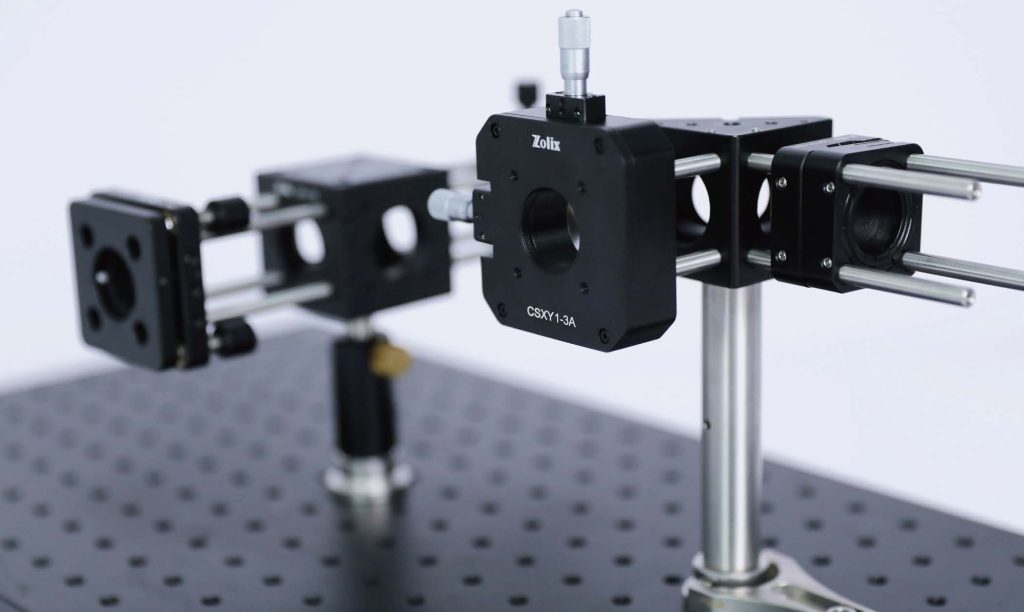
Precision optomechanical components for lasers, microscopy, spectroscopy and optical systems
Designing a high-performance optical system involves much more than choosing the right laser, lens or detector. Optomechanics provide the mechanical structure, stability and precision needed to position, align and control those optical components.
From a simple laboratory laser setup to a complex Raman microscope, hyperspectral imaging system or OEM instrument, the mechanical design of the optical system can have a direct impact on performance.
Photonic Solutions supplies a comprehensive range of optomechanical components and optical mounting systems for research, industrial and OEM applications. Our portfolio includes kinematic mirror mounts, lens mounts, laser mounts, prism mounts, optical posts and holders, optical cage systems, filter mounts, spatial filters, motion-control systems, optical tables and optical breadboards.
We also supply specialist optical components, including optical filters and laser optics, allowing optomechanics to be selected as part of a complete photonics system.
This guide explains what optomechanics are, how the different components work, how to choose the right products and how they are used in lasers, microscopy, spectroscopy, imaging and precision measurement.
What is optomechanics?
Optomechanics is the design and use of mechanical components that mount, position, align and control optical components.
Optomechanical components provide the physical interface between an optical element and the rest of an optical system.
They can be used to:
- Hold lenses, mirrors and filters securely
- Position optical components accurately
- Adjust the angle of a mirror or prism
- Align a laser beam
- Control the position of a detector
- Maintain a defined optical axis
- Reduce unwanted movement and vibration
- Build modular optical assemblies
- Automate optical positioning
- Maintain alignment during operation or transport
Typical optomechanical components include optical mounts, mirror mounts, lens mounts, laser mounts, prism mounts, optical posts, cage systems, translation stages and optical tables.
The choice of optomechanics depends on the optical component, required adjustment, available space, environmental conditions and stability requirements.
Why are optomechanics important?
Light follows a precisely defined optical path. If a lens, mirror or laser moves by even a small amount, the beam can move, focus can change or coupling efficiency can decrease.
In a basic optical experiment, this might make alignment more difficult. In a precision instrument, however, mechanical instability can directly affect measurement accuracy.
Optomechanics therefore provide three fundamental functions:
Position
The component must be held at the correct location and optical height.
Alignment
The component must be positioned at the correct angle and orientation.
Stability
The component must remain in position during operation.
For this reason, precision optomechanics are an essential part of many photonics systems.
The main types of optomechanical components
Different optical systems require different mechanical components. The most common categories include:
- Kinematic mirror mounts
- Lens mounts
- Laser mounts
- Prism mounts
- Optical posts and post holders
- Optical cage systems
- Filter mounts and filter wheels
- Spatial filters and diaphragms
- Translation and rotation stages
- Optical tables and breadboards
- Vibration isolation systems
- Fibre and detector mounts
Photonic Solutions supplies these components individually or as part of a larger optical system.
Kinematic mirror mounts
Kinematic mirror mounts provide precise angular adjustment of mirrors for optical beam steering and alignment.
They are among the most widely used optomechanical components in laser laboratories.
A kinematic mount typically allows controlled adjustment of the mirror around two axes, usually referred to as pitch and yaw. This changes the direction of the reflected beam without significantly changing the position of the mirror.
Kinematic mirror mounts are used in:
- Laser beam steering
- Interferometry
- Spectroscopy
- Microscopy
- Imaging
- Metrology
- Quantum optics
- Ultrafast optics
Zolix kinematic mirror mounts
Photonic Solutions supplies a range of Zolix kinematic mirror mounts designed for different optical and mechanical requirements.
The range includes multi-axis, gimbal, coplanar and top-adjustment designs.
The OMxA Multi-Axis Kinematic Mount, for example, provides up to six-axis adjustment from a single mount. The range also includes NMUM five-axis mounts, OMMB coplanar mounts and OMUS stainless-steel mounts for applications requiring increased stability and environmental compatibility.
For systems where access to the adjustment mechanism is important, the NMVG top-adjust gimbal mount provides adjustment from above.


6
Explore Kinematic Mirror Mounts.
Lens mounts
A lens mount holds an optical lens securely while maintaining its position within the optical system.
Depending on the design, a lens mount can provide fixed positioning, translation, rotation or fine adjustment.
Lens mounts are commonly used for:
- Beam expansion
- Beam focusing
- Imaging
- Microscopy
- Laser systems
- Spectroscopy
- Beam conditioning
- OEM instruments
The required mount depends on the lens diameter, thickness, optical axis height and required adjustment.
Photonic Solutions supplies Zolix lens mounts in a range of configurations and sizes. The NLB Series, for example, supports lenses from 10 mm to 50.8 mm diameter.
Explore Lens Mounts.
Laser mounts
A stable laser mount helps maintain the position and direction of the laser beam.
This becomes particularly important when a laser forms the starting point of a long or complex optical path. Small changes at the source can become increasingly significant further along the beam path.
Photonic Solutions supplies laser mounts for laboratory, industrial and OEM applications, including Zolix mounting solutions for different laser form factors.
The range includes the LasRack2 heavy-duty laser rack mounting kit, NCM V-clamp mounts, MM Series mounts and LM Series laser mounts.
Laser mounts can be used with:
- CW lasers
- Pulsed lasers
- Ultrafast lasers
- DPSS lasers
- Diode lasers
- Research laser systems
- OEM laser instruments
Explore Laser Mounts.
Prism mounts
Prisms are used in optical systems for beam deviation, dispersion, wavelength separation and other applications.
A prism must be held securely while maintaining the required orientation. In many applications, adjustment is also necessary.
Photonic Solutions supplies Zolix prism mounts for a variety of optical configurations.
The NPM Series provides two-dimensional tilt and one-dimensional rotation, while the OMHS-PM Series provides three-axis kinematic adjustment for different prism geometries.
Prism mounts are useful in:
- Spectroscopy
- Laser systems
- Beam steering
- Dispersion experiments
- Optical research
- Educational laboratories
Explore Prism Mounts.
Optical posts and post holders
Optical posts and post holders form the mechanical framework of many free-space optical systems.
They allow mirrors, lenses, filters and other components to be positioned at a consistent optical axis height.
A typical laboratory setup may use:
Optical table → post holder → optical post → mount → optic
This modular approach makes it easy to change the optical layout as an experiment develops.
Posts and holders are particularly useful for:
- Laser laboratories
- Spectroscopy
- Microscopy
- Beam steering
- Research experiments
- Prototype instruments
Explore Optical Posts & Post Holders.
Optical cage systems
Optical cage systems provide a modular framework for constructing optical assemblies around a defined optical axis.
Instead of mounting every component independently to an optical table, cage systems connect optical components using rods, plates and mounting hardware.
This can make it easier to construct compact and repeatable optical systems.
Photonic Solutions supplies Zolix 30 mm optical cage systems, including cage plates, cubes, rods, mirror mounts, filter mounts and lens mounts.
Applications include:
- Microscopy
- Imaging
- Beam conditioning
- Laser systems
- Spectroscopy
- Experimental optical systems
- OEM instruments
The CSM1-F optical mount, for example, provides 360° manual rotation for 25.4 mm optics.


5
Explore Optical Cage Systems.
Filter mounts and filter wheels
Optical filters are used to select, reject or modify specific wavelengths.
In many applications, several filters may be required. A filter wheel allows different filters to be introduced into the optical path without manually dismantling the system.
This is particularly useful for:
- Fluorescence microscopy
- Spectral imaging
- Laser diagnostics
- Spectroscopy
- Imaging
- Research instruments
Photonic Solutions supplies Zolix filter wheels and filter mounts in configurations designed for different filter sizes and numbers.
The MFW Series can accommodate up to six or twelve filters, depending on configuration.
This makes filter wheels useful when an experiment needs to switch between multiple wavelength bands.
Explore Filter Wheels & Mounts.
Spatial filters and diaphragms
A spatial filter can be used to improve the spatial quality of a laser beam by removing unwanted spatial frequencies.
A typical spatial filtering system uses a focusing lens and a small pinhole or aperture. The pinhole blocks unwanted components while allowing the desired spatial distribution of the beam to pass.
Spatial filters are used for:
- Laser beam conditioning
- Beam clean-up
- Imaging
- Optical experiments
- Microscopy
- Interferometry
Photonic Solutions supplies Zolix spatial filtering solutions, including the NASF Series Spatial Filter, together with adjustable optical slits and diaphragms.
Explore our Spatial Filters and Diaphragms.
Precision optical motion control
Some optical systems require components to move in a controlled and repeatable way.
Optical motion control systems provide translation, rotation or focusing with much greater precision than manual adjustment.
Applications include:
- Automated microscopy
- Spectroscopy
- Optical alignment
- Beam positioning
- Focusing
- OEM instruments
- Precision measurement
Photonic Solutions supplies Zolix motion-control systems and NewScale miniature positioning technology.
The NewScale M3 platform includes:
- M3-LS Linear Smart Stages
- M3-L Micro Linear Actuators
- M3-RS Rotary Smart Stages
- M3-F Focus Modules
The M3-LS provides 6, 8 or 15 mm of linear travel, while the M3-RS rotary stage provides resolution better than 0.022°.


6
Explore Optical Motion Control.
Optical tables and optical breadboards
The mechanical foundation of an optical laboratory is often the optical table.
Optical tables and breadboards provide a rigid, stable surface for mounting optical components and reducing the effects of vibration.
External vibration can affect:
- Interferometers
- Microscopes
- Spectrometers
- Laser systems
- Quantum optics experiments
- Precision measurement systems
Photonic Solutions supplies Zolix optical tables, breadboards and vibration isolation systems.
The ZDT-P Series uses pneumatic vibration isolation and automatic self-levelling, while the MOT-F honeycomb optical breadboard combines rigidity with broadband vibration damping.
Explore Optical Tables.
Optical filters and optics
Optomechanics provide the mechanical structure of an optical system, but they work alongside the optical components themselves.
Photonic Solutions supplies a range of optical filters and laser optics, including:
- Bandpass filters
- Ultra-narrow bandpass filters
- Notch filters
- Dichroic filters
- Longpass filters
- Shortpass filters
- Laser optics
- Prisms
- Polarisation optics
For example, Alluxa ULTRA Series Bandpass Filters provide high transmission and strong out-of-band blocking for applications including fluorescence microscopy, Raman spectroscopy and spectral imaging.
For a more detailed explanation of optical filter technology, read our Ultimate Guide to Bandpass Filters.
Optomechanics for laser systems
Laser systems often contain multiple mirrors, lenses, filters and beam-steering components.
A typical free-space laser system might use:
Laser → Laser mount → Kinematic mirror → Lens mount → Spatial filter → Mirror mount → Detector
Each component must remain correctly aligned.
High-quality optomechanics can make initial alignment easier while improving the long-term stability of the system.
This is particularly important for:
- Ultrafast lasers
- High-power lasers
- CW laser systems
- Raman lasers
- OPO and OPA systems
- Beam delivery systems
- Laser diagnostics
Photonic Solutions supplies a wide range of laser technologies that can be combined with the appropriate optomechanical components.
Optomechanics for microscopy and imaging
Microscopy systems frequently combine multiple optical components within a compact optical path.
Lenses, mirrors, filters, objectives and detectors all need to remain accurately positioned.
Optomechanics can therefore be used to create stable optical paths for:
- Fluorescence microscopy
- Raman microscopy
- Confocal microscopy
- FLIM
- Hyperspectral imaging
- Multiphoton microscopy
- Laser scanning microscopy
The Photonic Solutions Microscopy & Imaging portfolio includes technologies for advanced imaging, microscopy and spectroscopy.
Optomechanical components can provide the mechanical infrastructure needed to integrate these technologies into research systems and custom instruments.
Optomechanics for spectroscopy
Spectroscopy systems often require precise positioning of the light source, sample, collection optics, filters and detector.
Optomechanics can help control:
- Beam alignment
- Focusing
- Sample positioning
- Filter selection
- Detector position
- Optical coupling
This makes optomechanics an important part of Raman spectroscopy, NIR spectroscopy, fluorescence spectroscopy and other optical measurement techniques.
Photonic Solutions supplies both the optical and mechanical technologies required for many spectroscopy applications.
Explore our Spectroscopy solutions.
Optomechanics for OEM instruments
OEM instruments often have different requirements from laboratory optical systems.
An OEM design may need:
- Compact components
- Repeatable positioning
- High mechanical stability
- Low-profile mounts
- Custom dimensions
- Automated adjustment
- Long-term reliability
- Integration with electronics or control systems
Miniature motion-control products such as the NewScale M3 range can be particularly useful where space is limited.
Modular optomechanical components can also simplify prototype development before moving towards a fully customised mechanical design.
For OEM applications, Photonic Solutions can help identify suitable components based on the optical architecture and mechanical requirements of the instrument.
Optomechanics for research and education
Optomechanics are fundamental to practical photonics research.
A modular optical system allows researchers to change beam paths, introduce new optics and modify experiments without rebuilding the entire setup.
A typical research laboratory might combine:
Optical table
↓
Posts and holders
↓
Laser mount
↓
Kinematic mirror mounts
↓
Lens mounts
↓
Filters / spatial filters
↓
Detector or spectrometer
This modular approach provides flexibility as research projects evolve.
Photonic Solutions supports Research & Education applications across lasers, spectroscopy, microscopy, imaging, optomechanics and diagnostics.
How to choose the right optomechanical component
Selecting the right mount or positioning system starts with the requirements of the optical component and the complete system.
1. What are you mounting?
Start by identifying the component:
- Mirror
- Lens
- Prism
- Filter
- Laser
- Fibre
- Detector
- Camera
The optic’s diameter, thickness and geometry will determine which mounts are suitable.
2. What adjustment do you need?
Ask whether the component needs:
- Fixed mounting
- Translation
- Rotation
- Pitch/yaw adjustment
- Three-axis positioning
- Multi-axis positioning
A fixed mount may be sufficient for a simple system, while a precision experiment may require a kinematic or motorised mount.
3. How important is stability?
For precision optical systems, stability can be just as important as adjustment range.
Consider:
- Mechanical rigidity
- Thermal expansion
- Vibration
- Environmental conditions
- Locking mechanisms
- Material selection
4. What optical height do you need?
Maintaining a consistent optical axis makes an optical system easier to assemble and align.
Check the height of your existing components before selecting posts and mounts.
5. How much space is available?
Compact systems may benefit from low-profile mounts, top-adjustment mechanisms or miniature motion stages.
6. Will the system be automated?
If components need to move repeatedly, consider motorised stages, actuators or closed-loop positioning rather than manual mounts.
7. Is the system intended for an OEM application?
For OEM instruments, consider the component’s size, weight, repeatability, environmental requirements and integration into the final instrument.
Building a stable optical system
Good optomechanical design starts with the complete optical architecture.
Rather than selecting individual components in isolation, consider how each part interacts with the next.
For example:
Laser beam delivery
Laser → Laser mount → Mirror mounts → Beam expansion → Focusing optics → Application
Raman spectroscopy
Laser → Beam steering → Focusing optics → Sample → Collection optics → Optical filters → Spectrometer
Fluorescence microscopy
Laser → Excitation optics → Filter → Dichroic → Microscope → Emission filter → Camera
Hyperspectral imaging
Illumination → Sample → Imaging optics → Filter wheel / spectral selection → Camera
This approach helps ensure that the optical components and optomechanics work together rather than creating mechanical constraints later in the design process.
Common optomechanics terminology
Understanding the terminology used by optomechanics manufacturers can make component selection easier.
| Term | Meaning |
|---|---|
| Optical mount | Mechanical component used to hold an optical element |
| Kinematic mount | Adjustable mount providing controlled angular positioning |
| Pitch | Rotation around one axis |
| Yaw | Rotation around another axis |
| Roll | Rotation around the optical axis |
| Optical axis height | Height of the centre of the optical path |
| Cage system | Modular mechanical framework for optical components |
| Breadboard | Rigid mounting surface with a regular hole pattern |
| Optical table | Rigid, vibration-controlled platform for optical experiments |
| Translation stage | Mechanism for controlled linear movement |
| Rotary stage | Mechanism for controlled angular movement |
| Post holder | Component used to secure an optical post |
| Spatial filter | System used to control the spatial frequency content of a beam |
Frequently asked questions about optomechanics
What are optomechanics used for?
Optomechanics are used to mount, position, align and control optical components including mirrors, lenses, filters, lasers, prisms and detectors.
What is the most common type of optical mount?
Kinematic mirror mounts and fixed lens mounts are among the most commonly used optomechanical components in free-space optical systems.
What is a kinematic mirror mount used for?
A kinematic mirror mount provides controlled angular adjustment of a mirror, allowing the direction of a reflected laser beam to be precisely aligned.
What is an optical cage system?
An optical cage system is a modular framework that holds optical components around a common optical axis.
What is an optical breadboard?
An optical breadboard is a rigid mounting platform used to support optical components. It normally incorporates a regular pattern of mounting holes.
Why do I need an optical table?
An optical table provides a stable platform and helps reduce the effects of vibration on sensitive optical experiments.
What optomechanics do I need for a laser?
A basic free-space laser system may require a laser mount, mirror mounts, lens mounts, optical posts and holders. More complex systems may also require beam-conditioning optics, spatial filters, translation stages and an optical table.
Can optomechanics be used for microscopy?
Yes. Optomechanical components are widely used to position lenses, filters, mirrors, lasers, objectives and detectors within microscopy systems.
Can optomechanics be used for spectroscopy?
Yes. Optomechanics are particularly useful for aligning lasers, focusing optics, positioning samples and detectors and integrating optical filters within spectroscopy systems.
Can Photonic Solutions help specify an optomechanical system?
Yes. Photonic Solutions can help identify suitable optomechanical components based on the optic being mounted, required adjustment, optical height, stability, available space and application.
Applications for optomechanics
Optomechanical components are used across a wide range of photonics applications.
Lasers
Optomechanics provide the mounts, beam-steering components and positioning systems needed to build stable laser systems.
Explore Photonic Solutions laser technologies →
Spectroscopy
Precision mounts and positioning systems help maintain the optical alignment required for Raman, NIR and other spectroscopy systems.
Microscopy and imaging
Optomechanics can integrate filters, lenses, lasers and imaging components into stable microscopy systems.
Explore Microscopy & Imaging →
Research and education
Modular optomechanics allow researchers to build, modify and expand experimental optical systems.
Explore Research & Education →
Quantum and nanotechnology
High-stability mounts, positioning systems and vibration-controlled platforms are important for sensitive optical experiments.
Industrial and manufacturing
Optomechanics support optical inspection, measurement, laser processing and automated instrumentation.
Explore Industrial & Manufacturing →
Choosing optomechanics for your application
There is no single “best” optical mount or optomechanical system. The right choice depends on the optic, optical path, required adjustment, stability, environment and application.
For a straightforward laser alignment system, a combination of posts and kinematic mirror mounts may be all that is required.
A microscopy system may need lens mounts, filter wheels, cage components and precision positioning.
An OEM spectrometer may require compact mounts and miniature motorised stages.
A vibration-sensitive research experiment may require a rigid optical table, vibration isolation and high-stability mounts.
The key is to specify the complete optical system, rather than selecting each mechanical component independently.
Photonic Solutions optomechanics and optics
Photonic Solutions supplies precision optomechanics and optical components for research, industrial and OEM applications.
Our portfolio includes:
Optical mounts
Optical systems
Precision positioning
Laboratory infrastructure
Optical components
Need help selecting optomechanics?
Selecting the correct mount, stage or optical support can be difficult when several components need to work together.
Photonic Solutions can help you select the right optomechanical components for your optical system.
Tell us what you are trying to mount, the optic size, required adjustment and application, and our technical team can help identify an appropriate solution.