
Understanding optical bandpass filters: how they work and how to choose the right filter
Optical filters play an important role in controlling the wavelengths of light within an optical system. By transmitting selected wavelengths while rejecting others, they can improve signal quality, reduce unwanted background light and help an instrument isolate the optical information that matters.
Among the different types of optical filter available, bandpass filters are particularly useful when a system needs to transmit a defined region of the spectrum while blocking wavelengths outside that range.
Bandpass filters are used across a wide range of photonics applications, from fluorescence microscopy and Raman spectroscopy to flow cytometry, hyperspectral imaging, LIDAR and industrial sensing.
Photonic Solutions supplies a range of high-performance optical filters from manufacturers including Alluxa and Gentec-EO. The portfolio includes standard and custom bandpass filters, ultra-narrow bandpass filters, notch filters, dichroic filters and other wavelength-management solutions.
In this guide, we explain what a bandpass filter is, how optical bandpass filters work, which specifications matter and how to select the right solution for your application.
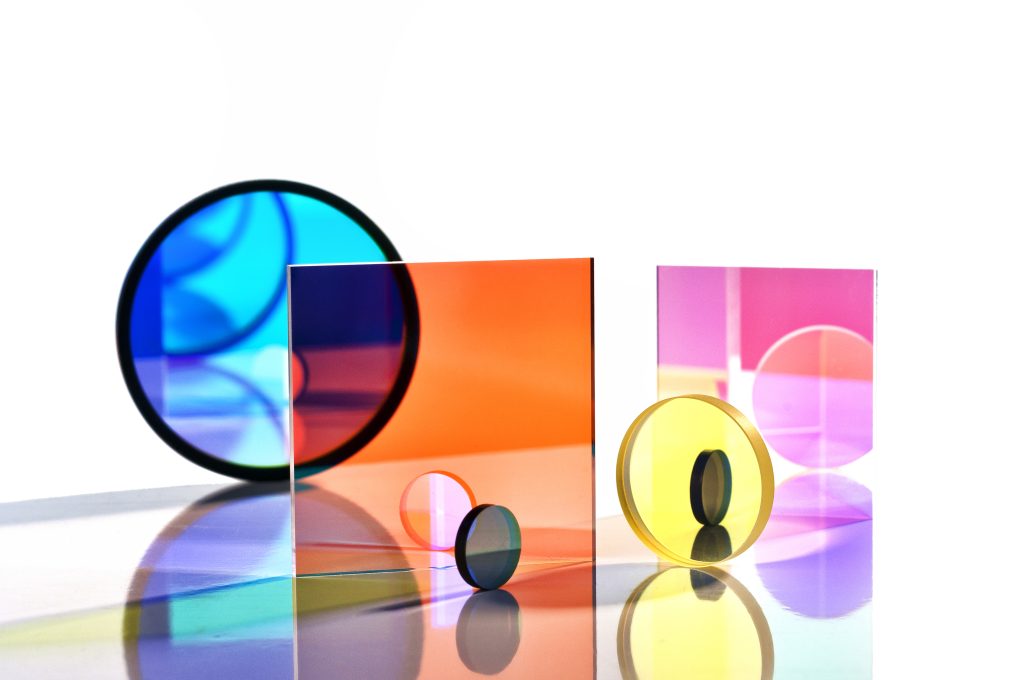
What is a bandpass filter?
A bandpass filter is an optical filter designed to transmit a defined range of wavelengths while attenuating light outside that range.
The wavelength region transmitted by the filter is known as the passband. The centre of this region is normally described by the centre wavelength (CWL), while the width of the transmitted region is described by the full width at half maximum (FWHM).
For example, a filter centred at 532 nm with a 10 nm FWHM would be designed to transmit light around 532 nm while substantially reducing transmission at wavelengths further away from the passband.
This makes bandpass filters particularly useful when an optical system needs to isolate a specific spectral feature or reject unwanted wavelengths.
Typical applications include:
- Fluorescence microscopy
- Raman spectroscopy
- Flow cytometry
- Spectral imaging
- LIDAR
- Optical sensing
- Laser diagnostics
- Biomedical imaging
- Astronomy
- Semiconductor inspection
- Industrial measurement
The required filter characteristics will depend heavily on the application. A fluorescence microscope, for example, may require excellent transmission at the emission wavelength and strong rejection of the excitation laser. A Raman system may require a very different combination of bandwidth, edge steepness and out-of-band blocking.
How does an optical bandpass filter work?
An optical bandpass filter uses wavelength-selective optical properties to control which parts of the spectrum are transmitted.
Modern high-performance filters often use thin-film interference coatings. These coatings contain carefully controlled layers of dielectric materials. As light interacts with the layers, constructive and destructive interference selectively enhances transmission within the desired wavelength range while suppressing unwanted wavelengths.
The design of the coating determines important characteristics such as:
- Centre wavelength
- Passband width
- Transmission
- Blocking range
- Edge steepness
- Wavelength tolerance
- Angle sensitivity
- Laser damage resistance
This approach allows manufacturers to produce filters with highly controlled spectral characteristics.
Alluxa’s ULTRA Series, supplied by Photonic Solutions, uses hard-coated thin-film technology and is designed for demanding optical instruments. Depending on the specification, filters can provide transmission of up to 99%, out-of-band blocking up to OD10 and edge transitions as steep as 0.5% of the centre wavelength.
Understanding the key bandpass filter specifications
Choosing an optical bandpass filter requires more than selecting a wavelength from a catalogue. Several specifications can affect the performance of the complete optical system.
Centre Wavelength (CWL)
The centre wavelength is the nominal wavelength around which the filter’s passband is centred.
For example, a filter specified at 532 nm is designed to transmit light around 532 nm.
The required centre wavelength normally comes from the wavelength of the signal you want to detect or transmit.
FWHM Bandwidth
FWHM, or full width at half maximum, describes the width of the passband at 50% of the peak transmission.
A narrow FWHM provides greater spectral selectivity, while a wider bandwidth allows a larger range of wavelengths to pass.
For example:
- 532 nm ± 1 nm → narrow spectral selection
- 532 nm ± 5 nm → wider transmission window
- 532 nm ± 25 nm → broad spectral selection
The correct bandwidth depends on the signal and the surrounding background that needs to be rejected.
Peak Transmission
Peak transmission indicates how much of the desired wavelength reaches the detector or subsequent optical component.
High transmission becomes particularly important when the available optical signal is weak, such as in fluorescence, Raman spectroscopy or low-light imaging.
Alluxa’s ULTRA Series bandpass filters can provide up to 99% transmission in the visible range, depending on the filter design.
Optical Density and Out-of-Band Blocking
A good bandpass filter should not only transmit the required wavelengths. It should also reject unwanted light effectively.
Optical density, commonly expressed as OD, provides a logarithmic measure of attenuation.
For example:
OD3 = 0.1% transmission
OD6 = 0.0001% transmission
OD10 = 0.000001% transmission
High optical density can be particularly important when a very strong unwanted signal sits close to a weak signal that needs to be measured.
Alluxa ULTRA Series filters can be designed with up to OD10 wide-range out-of-band blocking.
What is an ultra-narrow bandpass filter?
An ultra-narrow bandpass filter is designed to transmit a particularly small wavelength range while strongly rejecting light outside that region.
These filters are useful when spectral discrimination is critical.
For example, Alluxa’s Ultra-Narrow Bandpass Optical Filters can be designed with:
- Peak transmission up to 98%
- Blocking up to OD10
- Centre wavelength tolerances as tight as 0.05 nm
- FWHM bandwidths as narrow as 0.1 nm
- Centre wavelengths from approximately 250 nm to 6.2 µm
They are designed for applications including fluorescence microscopy, flow cytometry and DNA sequencing, as well as laser line and laser excitation filtering.
This level of performance can be valuable when a system needs to distinguish a narrow spectral feature from a strong background.
Bandpass filters for fluorescence microscopy
Fluorescence microscopy is one of the most important applications for optical bandpass filters.
A typical fluorescence imaging system uses a combination of optical filters to separate the excitation light from the fluorescence emitted by the sample.
A simplified system might look like:
Light source → Excitation filter → Sample → Emission → Dichroic → Emission bandpass filter → Camera
The excitation filter selects the wavelength used to illuminate the sample. The dichroic separates excitation and emission light, while the emission filter allows the required fluorescence signal to reach the detector.
This makes the transmission and blocking characteristics of the filters critical to image quality.
Alluxa’s ULTRA Series bandpass filters are specifically designed for fluorescence microscopy, with high transmission, steep spectral edges and strong out-of-band blocking.
Photonic Solutions also supplies optical technologies for Microscopy and Imaging, including fluorescence lifetime imaging, Raman microscopy, hyperspectral imaging and lasers for microscopy.
Related Photonic Solutions applications
Bandpass filters can therefore form part of systems used for:
- Fluorescence microscopy
- FLIM
- Confocal microscopy
- Multiphoton microscopy
- Raman microscopy
- Hyperspectral imaging
Bandpass filters for Raman spectroscopy
Raman spectroscopy presents a particularly demanding filtering requirement.
The Raman signal is typically much weaker than the excitation laser. Consequently, the optical system needs to suppress the intense excitation wavelength without removing the nearby Raman signal.
This is where notch filters, edge filters and specialised Raman filters can complement bandpass filters.
For applications that require selective transmission of a Raman spectral region, a narrow or ultra-narrow bandpass filter can provide additional spectral discrimination.
Alluxa’s ULTRA Series bandpass filters are specified for Raman spectroscopy, while its ULTRA Series notch filters can provide steep blocking around the excitation wavelength while transmitting the Raman Stokes and anti-Stokes signals.
Photonic Solutions’ wider Raman Spectroscopy portfolio includes Raman spectrometers and related technologies.
For Raman system designers, choosing the filter should therefore be considered alongside:
- Excitation wavelength
- Raman shift
- Required spectral range
- Detector sensitivity
- Laser power
- Laser linewidth
- Required rejection
- Spectrometer resolution
Bandpass filters for flow cytometry
Flow cytometry relies on optical systems to distinguish signals from fluorescently labelled cells and particles.
Multiple fluorescent markers may be measured simultaneously, so the detection system needs to separate overlapping emission bands.
Bandpass filters allow individual detector channels to select the required fluorescence range.
For example, one detector may use a green-region bandpass filter while another measures red or far-red fluorescence.
This approach allows several fluorescence signals to be measured simultaneously while reducing spectral overlap.
Alluxa’s bandpass and ultra-narrow bandpass filters are specified for flow cytometry, where high transmission and precise wavelength control can help optimise the detection path.
This makes high-performance optical filters relevant to Photonic Solutions’ Medical & Life Sciences applications.
Bandpass filters for spectral imaging
Spectral imaging combines spatial information with wavelength information. Optical filters can be used to isolate selected spectral regions before the detector.
This can be useful when an imaging system needs to identify differences between materials, biological structures or other spectral features.
For example, a filter wheel containing several bandpass filters can allow a camera to capture images at different wavelengths.
Photonic Solutions supplies hyperspectral and spectral imaging technologies through its Microscopy and Imaging portfolio. The IMA Global hyperspectral microscope, for example, can be configured with a filter wheel containing up to six bandpass filters.
This provides a useful connection between optical filter selection and the wider hyperspectral imaging systems available from Photonic Solutions.
Bandpass filters for LIDAR and sensing
LIDAR systems use light to make measurements of distance, position, velocity or atmospheric properties.
In many LIDAR systems, the detector needs to distinguish the returned signal from ambient light and other unwanted wavelengths.
A narrow bandpass filter centred on the laser wavelength can therefore improve the optical signal-to-background ratio reaching the detector.
The filter must, however, be selected carefully. Factors such as:
- Laser wavelength
- Laser linewidth
- Detector sensitivity
- Incidence angle
- Required field of view
- Ambient light
- Temperature stability
can all influence filter performance.
This makes bandpass filters particularly relevant to Photonic Solutions’ Sensing applications, which include technologies for metrology and environmental monitoring.
Bandpass filters for industrial and manufacturing applications
Optical filters are also increasingly important in industrial inspection and measurement.
A carefully selected bandpass filter can isolate wavelengths associated with a particular material, process or measurement technique.
Applications can include:
- Machine vision
- Semiconductor inspection
- Process monitoring
- Laser measurement
- Material identification
- Optical metrology
- Quality control
In these systems, the filter needs to deliver consistent performance while operating within the environmental and mechanical constraints of the instrument.
Photonic Solutions supplies optical technologies for Industrial & Manufacturing applications, including high-precision laser systems, inspection and analysis technologies.
Bandpass filters for pharmaceuticals and life sciences
Optical spectroscopy and fluorescence measurements play an important role throughout pharmaceutical research and manufacturing.
Bandpass filters can be used to isolate excitation or emission wavelengths, reduce background light and improve the selectivity of optical measurements.
Potential applications include:
- Fluorescence analysis
- Drug screening
- Biological imaging
- Flow cytometry
- Spectroscopy
- Process monitoring
Photonic Solutions supports the Pharmaceuticals sector with photonics technologies covering manufacturing and testing.
Bandpass filters for agriculture and environmental analysis
Optical spectroscopy and imaging are increasingly used for agricultural and environmental measurements.
Different materials interact with light in different ways, allowing spectral techniques to provide information about composition, condition and quality.
Bandpass filters can provide a relatively simple method of selecting specific wavelengths within an imaging or sensing system.
Potential applications include:
- Crop monitoring
- Plant analysis
- Soil analysis
- Environmental sensing
- Agricultural quality control
- Remote sensing
This complements Photonic Solutions’ Agriculture applications, which already brings together NIR, hyperspectral and atmospheric sensing technologies.
Bandpass filters in research and education
Research laboratories often need optical filters for experiments involving lasers, spectroscopy, imaging and photodetection.
Unlike a fixed industrial application, research systems can require unusual wavelengths, bandwidths or physical dimensions.
A custom filter can therefore be preferable to adapting an experiment around an off-the-shelf component.
Photonic Solutions supports Research & Education applications with a broad portfolio of lasers, spectroscopy, microscopy, optics and diagnostics.
Bandpass filters for quantum and nanotechnology
Quantum optics and nanotechnology experiments can place particularly stringent requirements on wavelength selection and optical background suppression.
Depending on the experiment, filters may need:
- Narrow spectral bandwidth
- High transmission
- Strong out-of-band rejection
- Low wavefront distortion
- Tight wavelength tolerances
- High laser damage resistance
These requirements make thin-film interference filters an important component in many advanced optical systems.
Photonic Solutions’ Quantum & Nanotech applications bring together technologies for quantum, advanced materials and nanotechnology research.
How to choose the right bandpass filter
When selecting a bandpass filter, start with the requirements of the complete optical system rather than the filter alone.
1. Define the centre wavelength
What wavelength needs to reach the detector?
This may be the emission wavelength of a fluorophore, a laser wavelength, a Raman feature or a spectral characteristic of the material being measured.
2. Determine the required bandwidth
Do you need to transmit a broad region or isolate a very narrow spectral feature?
A narrow FWHM can provide better discrimination, but it may also reduce the amount of useful signal reaching the detector.
3. Consider transmission
High transmission helps preserve the available signal.
This becomes especially important for weak signals, such as fluorescence and Raman emission.
4. Specify the required blocking
Consider what wavelengths need to be rejected and how strongly they must be attenuated.
A filter with excellent transmission but insufficient blocking may not deliver the required system performance.
5. Consider the angle of incidence
Interference filters can change their spectral response when used away from their specified angle of incidence.
If a filter will operate at an angle, specify this requirement when selecting the coating.
6. Check laser power
If the filter will be exposed to a high-power laser, make sure the coating and substrate can withstand the optical load.
Alluxa’s hard-coated ULTRA filters are designed for demanding applications and can be specified for high laser-damage resistance.
7. Consider environmental conditions
Temperature, humidity and mechanical stability can all affect an optical filter system.
For demanding applications, discuss the environmental requirements with the filter manufacturer before finalising the specification.
Bandpass filter vs notch filter
Bandpass and notch filters perform almost opposite functions.
A bandpass filter transmits a selected wavelength range and blocks wavelengths outside it.
A notch filter blocks a selected wavelength range while allowing wavelengths on either side to pass.
The distinction is particularly important in Raman spectroscopy.
For example, a Raman system may use a notch filter to remove the intense excitation laser while allowing the much weaker Raman signal to reach the detector.
Alluxa ULTRA Series notch filters are specifically designed for this purpose and can provide steep edges that help preserve Raman signals close to the excitation wavelength.
In simple terms:
| Filter | Main function |
|---|---|
| Bandpass filter | Transmits a selected wavelength range |
| Notch filter | Blocks a selected wavelength range |
| Longpass filter | Transmits wavelengths above a cut-on wavelength |
| Shortpass filter | Transmits wavelengths below a cut-off wavelength |
| Dichroic filter | Transmits and reflects different wavelength regions |
Choosing between them depends on what the optical system needs to transmit and what it needs to reject.
Bandpass filter vs dichroic filter
A dichroic filter uses wavelength-selective transmission and reflection rather than simply acting as a transmission window.
Dichroics are particularly useful when an optical system needs to separate two wavelength regions.
Fluorescence microscopes commonly use dichroic mirrors to separate excitation and emission light, while bandpass filters then refine the wavelengths reaching the sample or detector.
Photonic Solutions supplies ULTRA Series Dichroic Filters from Alluxa, including dichroic beamsplitters, polychroic filters and beam combiners. These can be custom designed with high transmission, high reflection and steep spectral transitions.
Alluxa ULTRA Series Bandpass Filters
The Alluxa ULTRA Series Bandpass Filters form the core of Photonic Solutions’ high-performance bandpass filter offering.
These hard-coated thin-film filters are designed for applications where wavelength accuracy, transmission and blocking are critical.
Depending on the specification, the ULTRA Series offers:
- Up to 99% transmission in the visible
- Up to OD10 out-of-band blocking
- Edge transitions as steep as 0.5% of CWL
- Centre wavelengths from approximately 250 nm to 6.2 µm
- CWL tolerances as tight as ±0.25% of CWL
- Low transmitted wavefront error
Available configurations include single-band, multiband, wideband, narrowband and ultra-narrowband filters. Custom designs are also available for demanding optical systems.
This flexibility makes the ULTRA Series suitable for applications ranging from fluorescence microscopy and flow cytometry to Raman spectroscopy, LIDAR and spectral imaging.
Alluxa Ultra-Narrow Bandpass Filters
Where maximum spectral selectivity is required, the Alluxa Ultra-Narrow Bandpass Optical Filters provide an alternative to conventional bandpass filters.
These filters can provide FWHM bandwidths as narrow as 0.1 nm, with centre wavelength tolerances as tight as 0.05 nm and blocking up to OD10.
They are particularly well suited to:
- Laser line filtering
- Laser excitation
- Fluorescence microscopy
- Flow cytometry
- DNA sequencing
- High-resolution spectroscopy
Gentec-EO UV bandpass filters
For UV applications, Photonic Solutions also supplies Gentec-EO filters.
The UG11-UV is a coloured-glass UV bandpass filter designed for wavelengths between approximately 250 and 370 nm. The 25 mm diameter filter provides an 80% clear aperture and has a typical damage threshold of 30 W/cm².
This provides a useful alternative where a simple UV wavelength-management solution is more appropriate than a high-performance thin-film interference filter.
Gentec-EO also supplies an IR filter that acts as a longpass filter, transmitting wavelengths above approximately 1250 nm.
Custom optical bandpass filters
Not every optical system can use an off-the-shelf filter.
OEM instruments and specialist research systems may require a particular combination of:
- Centre wavelength
- Bandwidth
- Transmission
- Blocking
- Physical dimensions
- Substrate
- Angle of incidence
- Environmental stability
- Laser damage threshold
In these situations, a custom optical filter can provide a better solution.
Photonic Solutions works with Alluxa to develop custom optical filters and thin-film coatings for demanding applications. The existing Custom Filter Sets service provides a route to specifying filter sets around a particular instrument or optical system.
If you cannot find a standard filter that meets your requirements, provide Photonic Solutions with your wavelength, bandwidth, transmission, blocking and physical specifications. The team can then help determine whether a standard or custom solution is appropriate.
Bandpass filter selection checklist
Before specifying a filter, consider the following:
Wavelength
- What centre wavelength do you require?
- Is the wavelength fixed or tunable?
Bandwidth
- What FWHM is required?
- Would a narrow or ultra-narrow filter provide an advantage?
Transmission
- What minimum transmission is acceptable?
Blocking
- Which unwanted wavelengths must be rejected?
- What optical density is required?
Optical power
- Will the filter be exposed to a laser?
- What damage threshold is required?
Geometry
- What diameter or physical dimensions are required?
- What is the angle of incidence?
Environment
- What temperature range will the filter experience?
- Will it be used in a vacuum or harsh environment?
Application
- Is the filter being used for fluorescence?
- Raman?
- Spectral imaging?
- LIDAR?
- Sensing?
- Laser diagnostics?
- Industrial inspection?
Having these specifications available makes it much easier to select the right filter.
Why choose Photonic Solutions for optical filters?
Photonic Solutions supplies optical filters as part of a wider portfolio of lasers, spectroscopy, microscopy, imaging, optomechanics and diagnostics. This broader technical capability is particularly useful when an optical filter forms part of a larger instrument rather than being used as an isolated component.
Our optical filter portfolio includes Alluxa ULTRA Series bandpass and ultra-narrow bandpass filters, notch filters, dichroic filters and custom filter solutions, together with Gentec-EO UV and IR filters.
Whether you are developing a fluorescence microscope, Raman instrument, hyperspectral imaging system, LIDAR receiver or industrial optical sensor, we can help you select a filter based on the requirements of the complete optical system.
Need help selecting an optical bandpass filter? Contact Photonic Solutions with your wavelength, bandwidth, transmission and blocking requirements.
Frequently Asked Questions
What is an optical bandpass filter?
An optical bandpass filter transmits a selected range of wavelengths while attenuating light outside that range.
What is FWHM in a bandpass filter?
FWHM stands for full width at half maximum. It describes the width of the filter’s passband at 50% of its peak transmission.
What is centre wavelength?
Centre wavelength, or CWL, describes the nominal central wavelength of a filter’s passband.
What is the difference between a bandpass and notch filter?
A bandpass filter transmits a selected wavelength range. A notch filter rejects a selected wavelength range while transmitting wavelengths outside it.
What is an ultra-narrow bandpass filter?
An ultra-narrow bandpass filter transmits a very small spectral region and provides strong rejection outside the passband. Alluxa filters can provide bandwidths as narrow as 0.1 nm.
Are bandpass filters used in fluorescence microscopy?
Yes. Bandpass filters are widely used to select excitation and emission wavelengths in fluorescence imaging systems.
Are bandpass filters used in Raman spectroscopy?
Yes. Bandpass filters can provide spectral selection in Raman systems, while notch and edge filters are often used to suppress the excitation laser.
Can bandpass filters be customised?
Yes. Alluxa filters can be custom designed around specific wavelength, bandwidth, transmission, blocking and physical requirements.
What wavelength range is available?
Photonic Solutions supplies bandpass filters covering wavelengths from the UV through to the mid-IR, depending on the manufacturer and filter design. Alluxa ULTRA Series filters can be specified from approximately 250 nm to 6.2 µm.
Choosing the right optical filter
A bandpass filter is only one part of an optical system. In many applications, the best performance comes from combining several carefully selected components.
For example:
Fluorescence microscopy
Laser → Excitation filter → Sample → Dichroic → Emission bandpass filter → Camera
Raman spectroscopy
Laser → Sample → Collection optics → Notch/edge filter → Spectrometer
Spectral imaging
Illumination → Sample → Bandpass/filter wheel → Camera
LIDAR
Laser → Target → Collection optics → Narrowband filter → Detector
Understanding the complete optical path makes it easier to specify the right filter and avoid unnecessary compromises.


