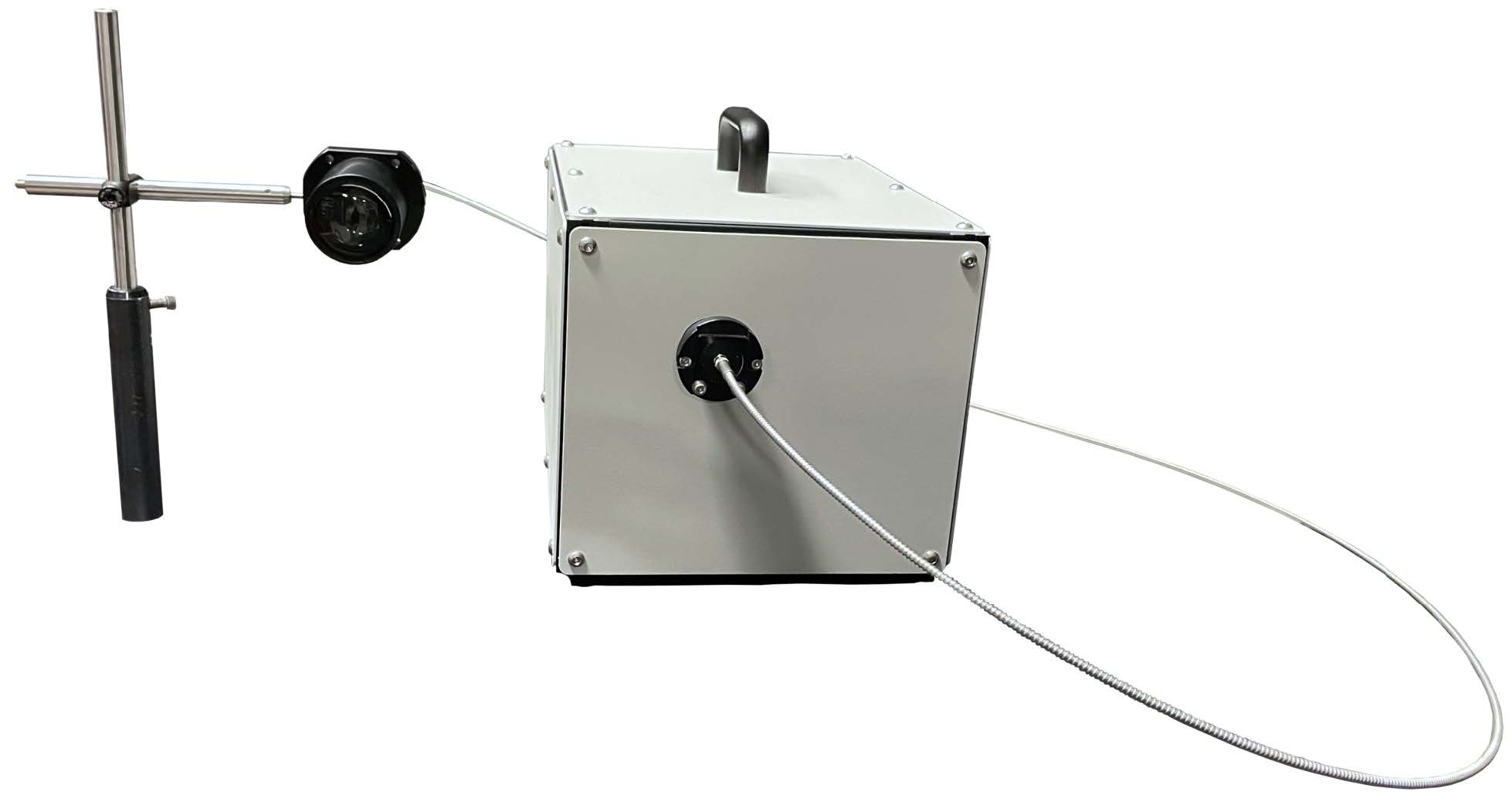
The ScienceTech SciPulseSpec is a high-performance pulsed spectroradiometer designed for the precise characterisation of pulsed light sources, including flash lamps, LEDs and solar simulators. Combining microsecond-range temporal resolution with calibrated spectral measurements, SciPulseSpec enables researchers and engineers to analyse the spectral irradiance and temporal behaviour of light sources under realistic operating conditions.
Designed specifically for applications involving solar simulator testing, SciPulseSpec captures the spectral characteristics of individual light pulses with integration times from 50 to 1,000 µs. An integrated optical triggering system synchronises measurements with the light source, allowing users to investigate changes in spectral output throughout a pulse. Its intended irradiance range of 0.5–1.5 Suns (500–1,500 W/m²) makes it particularly suitable for photovoltaic research and solar simulator characterisation.
The system covers a 300–1,050 nm spectral range, spanning ultraviolet, visible and near-infrared wavelengths. With a spectral resolution of 1.2 nm and wavelength accuracy of ±0.5 nm, SciPulseSpec provides detailed spectral information for quantitative analysis. Integrated spectral irradiance calibration, traceable to NIST standards, and automatic irradiance calculations help simplify measurement workflows and support reliable comparison between light sources.
SciPulseSpec includes fused-silica fibre optics and collection optics, together with BNC connections for pulse monitoring, trigger signals and shutter output monitoring. The accompanying RunSpectrometer software supports automated measurement sequences, user scripting and data visualisation, making it suitable for repeatable testing and customised experimental workflows.
Although designed primarily for pulsed sources, SciPulseSpec can also measure continuous-wave light sources when used with a shutter or another suitable modulation method to activate its optical trigger.
Typical applications include pulsed solar simulator characterisation, photovoltaic research, LED testing, flash lamp analysis, adaptive lighting systems and spectral irradiance measurement.