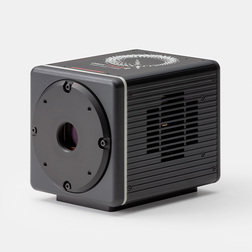
The Hamamatsu ORCA-Quest is a high-sensitivity scientific CMOS camera designed for ultra-low-light imaging, quantitative microscopy and demanding scientific imaging applications. Combining a high-resolution sensor with exceptionally low read noise, the ORCA-Quest is designed to capture weak optical signals while maintaining the speed and resolution required for advanced live-cell imaging and other quantitative measurements.
The ORCA-Quest uses Hamamatsu’s qCMOS technology, developed to reduce read noise while maintaining a large pixel count and high-speed readout. The current ORCA-Quest 2 provides 9.4 megapixels (4096 × 2304) with 4.6 µm pixels and achieves read noise as low as 0.30 electrons RMS in ultra-quiet scan mode. Peak quantum efficiency is approximately 85%, providing high sensitivity across the camera’s spectral response.
A key advantage of the ORCA-Quest platform is its ability to perform photon number resolving (PNR) imaging. Ultra-quiet operation enables detection of extremely weak signals, making the camera particularly valuable where conventional sCMOS cameras may struggle to distinguish low-level optical signals from electronic noise. The ORCA-Quest 2 can also achieve up to 120 frames/s at full resolution using CoaXPress, while USB operation provides up to 17.6 frames/s at full resolution.
The camera is available with forced-air or water cooling, with deep cooling helping to minimise dark current during long exposures. External triggering, multiple digital output formats and USB 3.1 Gen 1 or CoaXPress connectivity provide flexible integration into automated imaging systems.
Applications include fluorescence microscopy, super-resolution microscopy, bioluminescence imaging, quantitative imaging, quantum optics, astronomy and low-light scientific research. The combination of low noise, high quantum efficiency, resolution and readout speed makes the ORCA-Quest particularly suitable for experiments where both sensitivity and quantitative image data are important.